Gallery

Saturday, December 17, 2011

Here come ol' flat top...

It's way past noon and I'm still indoors, having a chat with my best friend about photography and the possibilities of what to photograph. The agreed theme for the afternoon's shoot eventually becomes "take a photo of nothing". Almost as soon as it is agreed I have at least one idea enter my head as to what that might be. The final outcome is anything but.

The exercise is to have a walking meditation with a camera over my shoulder, although I bend the rules a bit (well, quite a bit, actually) and take my bike instead. I did stick to the other part of the deal, however, and took just a single prime lens for the afternoon's shoot.

I start in a local park, photographing pine cones and fallen leaves on the grass, but soon find myself on the cliff top of Poole Bay, Dorset, and become fascinated with a distant storm cloud, seen here apparently positioned over the Isle of Wight on the horizon. The warm air rising in the cloud eventually creates the characteristic flat top, which can be estimated at around 36,000 feet  (7 miles/11km), as it reaches the tropopause, between the stratosphere and the colder air of the troposphere. There, I said it.


50mm f/1.8 AF Nikkor. 1/125 second at f/11. - 0.67 EV compensation. ISO 200


© 2011

Tuesday, December 13, 2011

Blue skies and sooty-grey...


After last night's strong winds and heavy rain the day breaks clear and calm, and I have the idea to visit a location that I've not been to for over a year for some waterfowl photography. My camera bag is already loaded with a super-telephoto lens and body, so it's just a case of dressing appropriately (thermal everything) and get into the car and drive.

As I head to Eyeworth Pond in the New Forest it occurs to me that this is probably the first time I've driven anywhere since October, as I mainly use a bicycle to get to the nearer destinations, these days. It starts to rain on the way, but it's only showers and I remain confident of getting something useful.

Upon arrival I find I have the place to myself, but as I start to set up my gear I discover that in my haste to leave home I've forgotten an important part of my photographic kit: the quick release plate for the ball and socket head on my monopod. It normally remains permanently attached to the foot of my 300mm lens, but I removed it in favour of the geared tripod head when shooting the moon last week, and never replaced it. Of course it won't mount and I have no option but to hand hold the camera. This is only a problem during extended shoots due to the weight, but the light is good and the sky is blue, so I just stand and wait.

There is the usual selection of ducks and drakes on the pond, as well as a cormorant, much to my surprise, but it's the coots, with their red eyes and distinctive white shield that get my attention on this visit. Although they appear black at first glance their plumage is in fact a sooty-grey, that can be seen in the photograph. The water ripples catch the sunlight and add some fill-in light to the feathers, highlighting their true colour.


300mm f/2.8 AF-S VR Nikkor with TC-14EII converter. 1/1250 second at f/4.5. - 0.33 EV compensation. ISO 500


© 2011

Saturday, December 10, 2011

Full, but not eclipsed...

As mentioned in yesterday's post, tonight it is full moon. Not only that, but there is a total eclipse of the Moon, although unless you live in the Shetland Islands in the UK it would not have been visible as such.

As it is, I'm thwarted by cloud cover by early evening from a photographic standpoint, and I resign myself to getting no shots of even a partially eclipsed disc in the sky.

I'm chatting with a friend on Skype in the late afternoon and making regular checks of the sky in the hope that something may appear. It's during one such visit outdoors that I see the cloud has broken sufficiently to get something on camera, so I hastily set up on a tripod and start making exposures.

Unlike yesterday, when I was able to expose solely for the Moon's disc, this time I have to compromise detail if I want to record the amazing cloud formation that contributes so much to the image. It's just not possible to record both within the latitude of a digital sensor or film. Something had to go.

300mm f/2.8 AF-S VR Nikkor with TC-14EII converter. 1/80 second at f/5. ISO 400. Tripod and remote release. Mirror lockup. Time: 17.26


© 2011

Friday, December 09, 2011

I see the Moon...


Over the past month or so I've freely given out information on Facebook and via Skype, to those that have asked, of how to photograph the Moon. I start with all the usual advice of: use a tripod, a remote release (or the camera's self timer) and to focus and expose manually, but it occurred to me, as I stepped out of the house and spied Earth's satellite: damn it, man, can you actually do it yourself?

It's been some time since I've made any serious attempt so I thought it was about time I brushed up on the technique. Now, the moon is brighter than most people think, especially now that it is nearly full (that occurs tomorrow) so pretty fast shutter speeds can be employed to help capture sharp images under high magnifications.

One other invaluable tip I can offer is to use the mirror lockup feature if your camera has one (we are generally talking SLR bodies, here). Once that is up and out of the way a few moments can be allowed for all vibrations to die down before the shutter is fired. Despite advanced damping engineered into modern camera bodies, the mirror is still capable of taking the edge off images such as these as it clatters up before the shutter blinds open. Some camera bodies also cause the mirror to be locked up when the self timer is activated, but I prefer to judge the exact moment of exposure myself.


300mm f/2.8 AF-S VR Nikkor with TC-14EII converter. 1/800 second at f/6.3. ISO 320. Tripod and remote release. Mirror locked up. Time: 16.46 GMT


© 2011

Cloud shadows...


At one time I would have set the alarm clock for early starts, but these days I appear to leave it purely to chance that I will wake up before dawn to go out for some early morning shooting. Mind you, there haven't been too may good opportunities for good light of late, so I don't feel I have missed anything.

This morning it is cold. Cold enough to wear thermal underwear, but I don't. I'm only intending to stay until the sun breaks the horizon, but a distant cloud bank scuppers that idea. Even so, I needed those thermals.

I spend around 50 minutes shooting aircraft contrails, dog walkers and passing birds as the light becomes more and more interesting. The sun rose at 7.56am, but it's some 30 minutes later before I shoot the image of shadows cast upon the sky by the clouds.

I do wish I had worn those thermals.

70-200mmf/2.8 Apo Sigma lens. 1/5000 second at f/5.6. ISO 640


© 2011

Saturday, December 03, 2011

Silver sea...


The weather forecast for today was way off. Overcast with some rain was predicted, but by early morning the clouds had rolled away and blue skies prevailed.

It was mid afternoon before I ventured out with a camera, and once again I chose the seaside for my shooting location. I could have (and did) make all the usual shots of walkers on the surf line, or cloud formations, but just before the sun dipped down behind a cloud bank to the West, I took a series of photographs which I knew I would convert to black and white as I fired the shutter. Pointing the lens into the light produced a high contrast mono image. Just the way I like 'em.

70-200mm f/2.8 Apo Sigma lens. 1/800 second at f/8. + 1 stop EV compensation. ISO 400


© 2011

Friday, December 02, 2011

December dawn...

A pre-dawn inspection of the sky from my bedroom window confirms yesterday's weather forecast: it's clear. It takes me just a few moments to pack my camera bag with two lenses, have breakfast and cycle to the beach at Southbourne, Bournemouth, and photograph the sunrise.

Conditions are near perfect and couldn't be more different to the corresponding day last year at the same location. The sun rises at 7.47am and I start making photographs. I'm lucky this morning as the cloud bank near the horizon allows me to shoot the sun as it appears over the sea, then shortly after gives me a sunburst from behind the cloud while it is still low in the sky.


70-200mm f/2.8 Apo Sigma lens. 1/200 second at f/11. + 0.33 EV compensation. ISO 400

© 2011

Sunday, November 27, 2011

Kites and herring gulls...


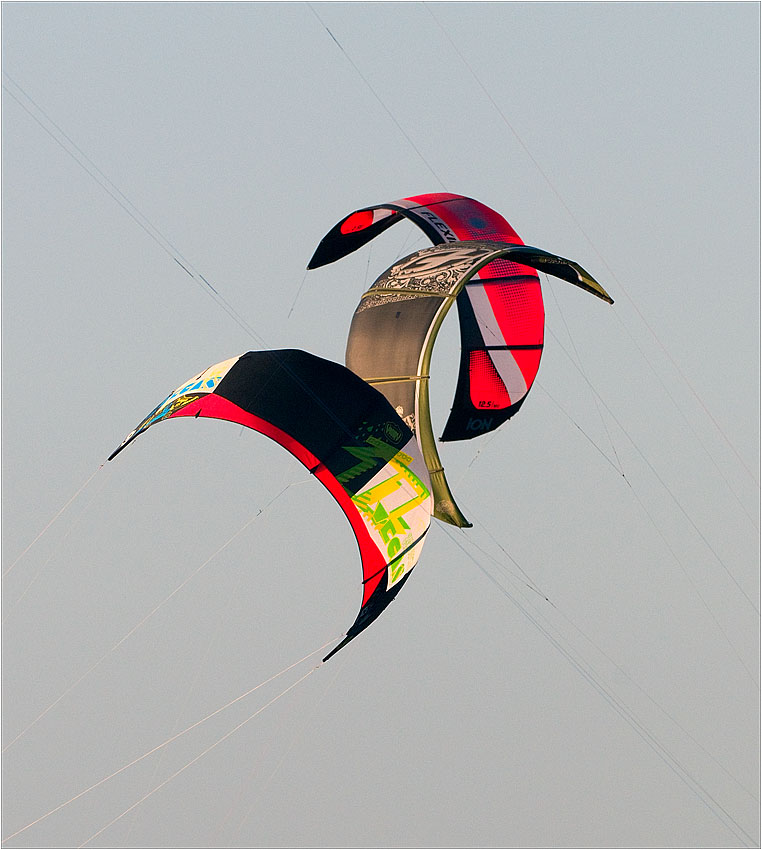
The heavy cloud of early morning gives way to blue skies and crisp autumn weather. A brisk westerly wind is blowing, and I know conditions are right for the kite surfing enthusiast, so I pack my longest lens and cycle to Sandbanks, on the southern shore of Poole Harbour. Despite the fact that I'm already shooting with a tele-converter attached to a 300mm lens the surfers themselves are too far from the shore to get frame filling images, so I opt to shoot the kites themselves (above).

Having stood for more than an hour in one spot the wind chill gets the better of me and I decide to head home - a bit of exercise will soon warm me up. As the sun sinks low on the horizon I come across a herring gull perched on a groyne head.


Normal procedure in this scenario is: I edge carefully towards my subject, making no sudden moves, slowly and quietly unpack my camera with telephoto lens attached, fix the assembly to the monopod and begin to frame the subject... at which point it flies off before I can make an exposure. Except in this case it didn't happen. The gull was more than happy (it seems) to be photographed on Bournemouth beach in the late afternoon sun.


Both images: 300mm f/2.8 AF-S VR Nikkor with TC-14E converter.

Top: 1/1000 second at f/8. - 0.33 EV compensation.
Below: 1/800 second at f/4.5
ISO 400

© 2011

Thursday, November 24, 2011

Arctic Sunrise...


I have a feeling the mild weather we have been experiencing in the South West of the UK is about to depart for cooler conditions, although the wind chill factor from a stiff south-westerly no doubt played a part, today.

I cycled to Poole Harbour, mainly for the exercise, but as always, I had my camera with me. Upon arrival at Sandbanks I was aware of the Greenpeace ship Arctic Sunrise leaving port, and I had to race it to the harbour entrance to get into position to photograph the vessel as it passed before Brownsea Island (photo). I had no inkling that the ship was in port, but obviously others did as there were more photographers than usual toting cameras in the area.

70-200mm f/2.8 AF Apo Sigma lens. 1/500 second at f/5.6. - 0.33 EV compensation. ISO 400


© 2011

Saturday, November 19, 2011

Rim light and motion blur...

The relatively mild weather of southwest England continues, and according to one dog walker I spoke to on Stanpit Marsh, Dorset, it's set to continue until at least the end of the month. I had arrived on the marsh during mid afternoon with my longest lens, but no real idea of what I intended to shoot. I took a number of "warm-up" shots before coming across the same chap who I bumped into a couple of weeks ago, counting the ponies. I ask him if he is still to arrive at a consistent count, but he tells me that he counts them every Saturday. He also tells me that a Glossy Ibis is still on the marsh and directs me to the general area.

He is, of course, right, but the bird remains tantalisingly out of range of my longest lens, even with a teleconverter attached. It's while I wait for the ibis to move closer (it never does) I turn and see a lone marsh pony - rim lit, along with the reeds - against the setting sun.


Once the sun dips below the horizon I decide to call it a day. I chat for a while with someone out walking and taking the crisp evening air, but it is just as we are both about to leave that a skein of Canada Geese appear from the North. I instinctively raise the camera to my eye and make a number of exposures as I follow their flight. In my haste I failed to make appropriate camera settings, and shot hand held with a shutter speed that was far too low to get sharp images. Not deterred, I open the files on my computer and find that some of these images have a pleasing blur, giving the feeling of movement to the photograph. Sometimes an error can still produce a useable photograph.


Both images:
300mm f/2.8 AF-S VR Nikkor with TC-14E converter.
Top: 1/500 second at f/5. + 0.67 EV compensation. ISO 400
Bottom: 1/60 second at f/4.5. + 1 stop EV compensation. ISO 400


© 2011