Sunday, November 27, 2011
Kites and herring gulls...
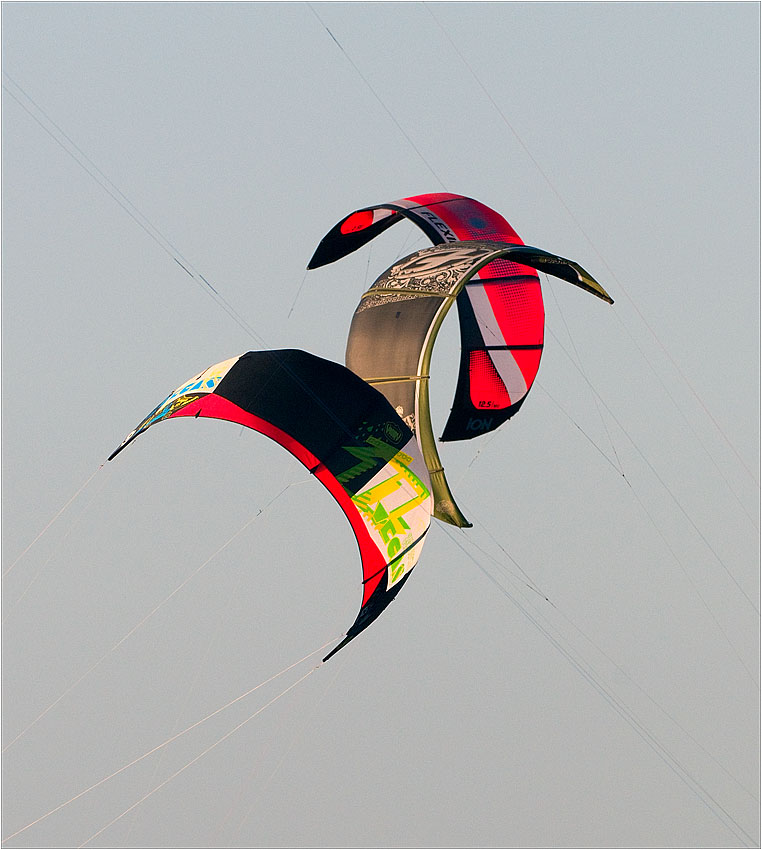
The heavy cloud of early morning gives way to blue skies and crisp autumn weather. A brisk westerly wind is blowing, and I know conditions are right for the kite surfing enthusiast, so I pack my longest lens and cycle to Sandbanks, on the southern shore of Poole Harbour. Despite the fact that I'm already shooting with a tele-converter attached to a 300mm lens the surfers themselves are too far from the shore to get frame filling images, so I opt to shoot the kites themselves (above).
Having stood for more than an hour in one spot the wind chill gets the better of me and I decide to head home - a bit of exercise will soon warm me up. As the sun sinks low on the horizon I come across a herring gull perched on a groyne head.
Normal procedure in this scenario is: I edge carefully towards my subject, making no sudden moves, slowly and quietly unpack my camera with telephoto lens attached, fix the assembly to the monopod and begin to frame the subject... at which point it flies off before I can make an exposure. Except in this case it didn't happen. The gull was more than happy (it seems) to be photographed on Bournemouth beach in the late afternoon sun.
Both images: 300mm f/2.8 AF-S VR Nikkor with TC-14E converter.
Top: 1/1000 second at f/8. - 0.33 EV compensation.
Below: 1/800 second at f/4.5
ISO 400
© 2011
Thursday, November 24, 2011
Arctic Sunrise...
I have a feeling the mild weather we have been experiencing in the South West of the UK is about to depart for cooler conditions, although the wind chill factor from a stiff south-westerly no doubt played a part, today.
I cycled to Poole Harbour, mainly for the exercise, but as always, I had my camera with me. Upon arrival at Sandbanks I was aware of the Greenpeace ship Arctic Sunrise leaving port, and I had to race it to the harbour entrance to get into position to photograph the vessel as it passed before Brownsea Island (photo). I had no inkling that the ship was in port, but obviously others did as there were more photographers than usual toting cameras in the area.
70-200mm f/2.8 AF Apo Sigma lens. 1/500 second at f/5.6. - 0.33 EV compensation. ISO 400
© 2011
Saturday, November 19, 2011
Rim light and motion blur...
The relatively mild weather of southwest England continues, and according to one dog walker I spoke to on Stanpit Marsh, Dorset, it's set to continue until at least the end of the month. I had arrived on the marsh during mid afternoon with my longest lens, but no real idea of what I intended to shoot. I took a number of "warm-up" shots before coming across the same chap who I bumped into a couple of weeks ago, counting the ponies. I ask him if he is still to arrive at a consistent count, but he tells me that he counts them every Saturday. He also tells me that a Glossy Ibis is still on the marsh and directs me to the general area.
He is, of course, right, but the bird remains tantalisingly out of range of my longest lens, even with a teleconverter attached. It's while I wait for the ibis to move closer (it never does) I turn and see a lone marsh pony - rim lit, along with the reeds - against the setting sun.
Once the sun dips below the horizon I decide to call it a day. I chat for a while with someone out walking and taking the crisp evening air, but it is just as we are both about to leave that a skein of Canada Geese appear from the North. I instinctively raise the camera to my eye and make a number of exposures as I follow their flight. In my haste I failed to make appropriate camera settings, and shot hand held with a shutter speed that was far too low to get sharp images. Not deterred, I open the files on my computer and find that some of these images have a pleasing blur, giving the feeling of movement to the photograph. Sometimes an error can still produce a useable photograph.
Both images:
300mm f/2.8 AF-S VR Nikkor with TC-14E converter.
Top: 1/500 second at f/5. + 0.67 EV compensation. ISO 400
Bottom: 1/60 second at f/4.5. + 1 stop EV compensation. ISO 400
© 2011
Thursday, November 17, 2011
Green light...
Often seen, but never photographed by me, today I was lucky enough to witness military training at Sandbanks, Dorset. I first spotted the Lockheed C-130 Hercules transport plane circling overhead from Bournemouth pier as I was out for an afternoon ride. I took a few token shots from a distance, and without a second thought carried on my way west. It wasn't until I arrived at the western end of Poole bay some 20 minutes later that I realised the aircraft was still in the area; still circling.
I began to make a series of photographs as the plane made a number of passes in the hope that its contents were still onboard, but despite the aircraft's main door being open there was nothing forthcoming. Finally, the Hercules disappeared into the distance, so I spent time making attempts to photograph gulls in flight.
Around 35 minutes later, to my surprise, it returned and continued the same flight pattern that I had witnessed earlier. Nevertheless, I kept a watchful eye on the plane, and was eventually rewarded with what I had been waiting for. The photograph shows a number of British Army Marines on a training exercise, jumping from the rear of the aircraft and parachuting into the sea near Old Harry Rocks on the Dorset coast.
300mm f/2.8 AF-S VR Nikkor with TC-14E converter. 1/2000 second at f/8. - 0.33 EV compensation. ISO 400
© 2011
Saturday, November 12, 2011
Unseasonably warm...
I rode the full length of Poole Bay, Dorset, to start with, taking a number of images of Hengistbury Head at the Eastern end to get me started. There was a good deal of haze and that, mixed with the autumn light, produced the top image. In essence I photographed the light, not the subject.
Upon reaching the Sandbanks end of the bay I was attracted by a variety of gulls, squabbling over scraps of bread being fed to them. Their behaviour is predictable in this activity as they wheel overhead, waiting for their opportunity to swoop and grab what they can. This is where the telephoto zoom shines, as I can constantly reframe as the birds approach my position, shooting when they have in a good orientation to the camera. Prime lenses restrict this, often forcing me to shoot before the subject fills the frame, or sometimes too late, and part of the bird is lost out of frame.
Both photos: 70-200mm f/2.8 Apo Sigma lens.
Top: 1/400 second at f/8. ISO 500. Polarising filter
Below: 1/2000 second at f/5.6. ISO 400
© 2011
Thursday, November 10, 2011
Lucky break...
The weather has been typical for the time of year over the past week or so, with grey skies and light rain. However, today the clouds cleared long enough for some late afternoon sunshine. On the bike with two lenses in the bag, and heading for the shore.
Although very mild for the time of year, there were very few people taking advantage of the sea air. I'm shooting mainly cloud formations, lit by the setting sun, but two dog walkers time it perfectly and stroll into the frame as the sun breaks through the cloud bank to the West. There were no other people on the beach itself. Piece of luck.
70-200mm f/2.8 Apo Sigma lens. 1/1250 second at f/6.3. +1 stop EV compensation. ISO 400
© 2011
Friday, October 28, 2011
The Daily Grind rides again...
Earlier in the week I had taken the decision to no longer continue with this blog, and left a post saying as much. What I didn't anticipate was the startling public reaction to the termination, and two comments from readers flooded in in protest, and to express their sorrow - and one of those is from someone whom I know.
So, as a gesture to the heartfelt outcry I agree to continue this blog, and post today's photograph of Stanpit Marsh ponies, with Christchurch Priory in the distance.
24-70mm f/2.8G AF-S Nikkor. 1/160 second at f/9. + 0.67 EV compensation. ISO 400. Polariser
© 2011
Saturday, October 15, 2011
Marsh pony...
I change my initial plans at the last minute, and visit Stanpit Marsh in Christchurch Harbour, Dorset, instead of a local nature reserve. It's the first time I've been there this year, and as last year, it is host to Glossy Ibis, except this time there are (apparently) three. I only see one.
No, it's the ponies that live on the marsh that get my attention this time around. I come across an official-looking chap, complete with binoculars and clip board, mumbling out loud and waving his biro around in a broad arc in an effort to count the number of the aforementioned creatures spread out before us. He is becoming exasperated by the fact they are continually on the move and they are mostly all the same colour. He makes four counts while I'm stood with him, but he can't decide whether the tally is 14 or 15. I count 15 twice, which is enough to convince me I was right the first time, and tell him so. We eventually concur, and he writes the figure in one of the columns on a form attached to his clip board.
"How many should there be?" I ask him.
"I don't know" comes his reply.
70-200mm f/2.8 Apo Sigma lens. 1/1600 second at f/5.6. - 0.67 EV compensation. ISO 400
© 2011
Labels:
Christchurch Harbour,
Dorset,
Marsh Ponies,
Stanpit Marsh
Location:
Christchurch, Dorset, UK
Friday, October 14, 2011
The Twin Sails Bridge...
The Indian summer experienced by most of the UK at the beginning of the month has long gone, but in some parts of the South, at least, we are still getting relatively good weather with temperatures remaining in the high teens Celsius: still bike weather.
Yesterday, whilst out riding, I unexpectedly happened upon the construction of a new lifting bridge being built in Poole, Dorset. I knew construction was underway and had made loose plans to photograph the process, but what with one thing and another it had slipped my mind. As a result the camera lens I was carrying was totally unsuitable for the job.
Today started clear and sunny, so I took the opportunity to return to the site, this time tooled-up with the right glass. The two 65 tonne leaves of the Twin Sails Bridge, each operated by two hydraulic rams, are not quite identical at this point, but the bridge is not scheduled to be opened until January of next year. When operational, the bridge will take two minutes to open, with a planned 3,500 lifts a year.
12-24mm f/4 Nikkor. 1/500 second at f/11. ISO 200
© 2011
Monday, October 10, 2011
...to leave the world behind
Red sky at night, as the old saying goes, usually means fine weather the following day, so I pack my camera bag with three lenses the night before and set the alarm clock for 6.00am. I’m up before the alarm goes off, and a quick look out of the window suggests I might be lucky. A swift breakfast, then on the bike and pedalling into a stiff(ish) breeze. By 7.00 am I’m stood on the beach at Canford Cliffs, Poole Bay, facing East and wait for nature to do its stuff. It doesn’t.
The time of sunrise comes...and passes, and nothing spectacular happens; it’s all grey cloud and the camera remains idle. Instead, I choose that moment to deliver a message to a distant friend. A cormorant flies low across the waves, and I suddenly become aware of a song that has surfaced of its own accord and is playing through my head. At this instant the sun illuminates the broken cloud and I make the shot.
Magic can happen.
24-70mm f/2.8G AF-S Nikkor. 1/400 second at f/8. - 0.33 EV compensation.ISO 400
© 2011
Thursday, October 06, 2011
New post; no photo...
A (very) rare post of text only, but it is to draw your attention to the Links section of this page (right), and in particular the heading:
Richard Brewer: Photography - an occasional series.
This is a new feature to the blog and it will contain images only, principally operating as a gallery of subject-related themes.
The first in the series is British Birds and Waterfowl, and features some of my favourite photographs taken since 2008.
Monday, October 03, 2011
Flight Lieutenant's memorial...
It was recently announced by Bournemouth Council that a permanent memorial will be dedicated to Red Arrows pilot Flt. Lt. Jon Egging, who died shortly after a display over the sea front in August when his Hawk jet crashed into fields near the local airport. At the time of writing no firm decision has been made as to what form it will take, but the townspeople are being invited to add their input. It is hoped the tribute will be in position for the start of next year's air festival.
Whilst researching the subject I came across a seemingly little-known story of another pilot who also lost his life during an air display at the Dorset (then Hampshire) town, and today I was able to locate his memorial on Bournemouth's East Cliff and photograph it.
The small plate, set into stone, has the inscription:
In memory of
Flt/Lt John Henry Green DFC, a Canadian wartime pilot with the RAF. Lost his life on 17th September 1947 when his Spitfire crashed into the sea between Boscombe and Bournemouth piers during a flying display in aid of the RAF benevolent fund, and to mark the anniversary of the Battle of Britain.
24-70mm f/2.8G AF-S Nikkor. 1/250 second at f/11. - 0.33EV compensation. ISO 400
© 2011
Monday, September 26, 2011
Heave ho, me hearties!
As predicted last week, the UK appears to be experiencing an Indian summer, with sunshine and temperatures of up to 28º C - 15º above normal for the time of year - and expected to last until early October. After a cloudy start to the day the clouds roll away and I ride to Poole harbour to shoot with a fast telephoto.
The idea is to concentrate on detail in the landscape; preferably something out of the ordinary, and it's a weather vane on top of a house in Sandbanks that catches my eye. The figure is of the fictional pirate Captain Pugwash: the main character of a British children's comic strip and TV show originating in the 1950s. He's seen here brandishing a cutlass to lay claim to a treasure chest on a tropical island; his ship Black Pig in the distance. The title of this post is one of his (many) catch phrases.
300mm f/2.8 AF-S VR Nikkor. 1/3200 second at f/5.6. -0.33 EV compensation. ISO 400
© 2011
Thursday, September 22, 2011
Adobe Photoshop and the digital age...
Over the past month or so I've had several discussions (and disagreements) with another photographer as to whether or not digital photography takes away the soul of an image, and whether or not it's the best thing since sliced bread: he maintains it is not. I don't care.
Today, digital imaging proved its worth from my perspective, as it enabled me to produce a useable photograph using the wrong lens for the job. The paddle steamer PS Waverley made its final appearance at Bournemouth during the South Coast excursion season, and by way of a change I opted to get some shots from a higher angle than sea level, using a super-telephoto lens to record the ship's arrival at 1.00pm. Unfortunately, local atmospheric conditions - the bane of long focal length optics - were producing images with poor resolution and weak colours: I needed to shoot when my subject was much closer than intended.
From my vantage point on the West Cliff of Bournemouth I was unable to accommodate the full length of the Waverley with a 300mm lens once it tied-up along side the pier: I was just too close. I could have moved back the distance required, but as the stop-over was for a mere 15 minutes I had precious little time to re-locate and reframe... so I shot a panoramic.
I alway shoot in the RAW format, but for this technique I switched the camera to its fine jpeg setting, purely to keep the final file size down to something manageable. I needed to make all the exposures identical, so I switched the camera to manual and shot the sequence in portrait format (upright), overlapping each exposure by roughly 30%. Once opened on my computer I had seven frames that needed to be stitched together by software (Adobe Photoshop) - the results of which can be see in the first photograph. After that I processed the image as I normally would, but in this case I cloned-in a bit of sea at the bottom of the picture and cropped out the bent horizon and sky (below).
The process produced a final image 70cm wide with a file size of 116mb, and the detail in the original is such that when zoomed in I can clearly identify individual passengers waiting to embark from the pier.
300mm f/2.8 AF-S VR Nikkor. 1/400 second at f/11. - 0.33 EV compensation. ISO 400. Monopod.
© 2011
Wednesday, September 21, 2011
Well, it surprised me...
Having drawn a blank in photographing the PS Waverley on Sunday, the weather conspires once again the day after, and sailings are cancelled. Time is running out as tomorrow is the last day of the South Coast excursions. Not only that, but I understand that future visits are doubtful due to operating costs; this may be my last chance.
Having checked the Waverley's web site yesterday I deduce that my last (and only) chance for some images now is on Thursday - no sailings, today - although the weather forecast doesn't look too promising. It's in the lap of the gods.
Despite a brisk westerly wind I decide to take a mid-day bike ride along the sea front of Poole Bay, Dorset; camera bag loaded for the first time in weeks, but nothing in mind to shoot... when I come upon the scene above. To my total surprise the aforementioned steamer is pulling up along side Bournemouth Pier as I arrive, shortly before 1pm. The light at this time of day is too brutal to get anything moody or pleasing, but I make a number of photographs as insurance against tomorrow's possibility of a no-show because of weather.
In this instance I use the RNLI lifeguard station and its attendant quad bike to add some interest and compensate for the less-than-photogenic lighting. I was also informed by a fellow photographer, whom I struck up a conversation with on the beach, that the Waverley was scheduled for a visit today; it was advertised it on its web site.
Missed that one!
24-70mm f/2.8G AF-S Nikkor. 1/320 second at f/11. - 0.33 EV Compensation. ISO 320. Polariser
© 2011
Sunday, September 18, 2011
I see no ships...
It is at this time of year - and this week in particular - that the PS Waverley, the only seagoing paddle steamer in the world, makes several excursions along the South coast. Time for some shots.
Having missed the departure from Bournemouth pier this morning (it was raining), I elect to do some early evening photography as the ship returns. It will be better light, anyway.
Once the excursions are underway all details are removed from the sailing schedule on its web site, so I'm forced into guessing what time this will be. Experience tells me roughly 6 - 6.30pm, so I'm cycling along the seafront at this time from Bournemouth to Sandbanks, keeping an eye out for the Waverley to hove into view on the horizon...but it doesn't happen.
Eventually I check the departure and arrival times at the entrance to the pier, and a notice informs me that today's sailing had been cancelled due to bad weather. Okay, it did rain and there were winds of up to 25mph along the coast, but surely it wasn't that bad? Still, better safe than sorry; I'll try again tomorrow (weather permitting). Oh yes, the photograph is a token shot whilst waiting on the beach at Canford Cliffs, Poole.
24-70mm f/2.8G AF-S Nikkor. 1/200 second at f/11. -0.33 EV compensation. ISO 320. Polariser
© 2011
Friday, September 16, 2011
Seasonal Limbo...
As mentioned in my last post, summer officially came to an end on 31st August. With the autumn equinox nearly upon us next week, it leaves me wondering what these three weeks of seasonal Limbo might be called.
Having ridden out the remnants of Hurricane Irene, which manifested itself only as brisk winds in the South, I return to Throop, Dorset, for some casual photography. Today's photograph was taken from the footbridge of the weir that crosses the Stour at this point, and I make no attempt to conceal the electricity pylons that straddle the landscape, using them as part of the composition.
As with the nearby millpond in my last post, the river itself has also been allowed to return to a more natural state, with far more weed and reeds evident than in all the years I've been going to the spot. I'm sure there is a good reason for deliberately letting the waterway get to this condition, but everyone I speak to locally is as mystified as I am.
24-70mm f/2.8G AF-S Nikkor. 1/125 second at f/11. - 0.67 EV compensation. ISO 250. Polariser.
© 2011
Friday, September 02, 2011
Carpeted swans...
Although I heard someone on the radio mention the other day that the end of August is the end of summer, the beginning of September belies that statement. Clear skies and temperatures reaching 23˚C are the order of the day, and I'm not going to waste it. I've spent too many days inside recently, pursuing other creative interests; it's time to get out.
Packing my longest lens I jump (figuratively speaking) on my bike and head for the countryside, and specifically Throop Mill, Dorset. Although I have waterfowl in mind I'm not intending to shoot anything serious, as it's the middle of the day and the sun is high overhead: not the best light.
For reasons best known to those who manage the area, the millpond has been allowed to become carpeted with (duck?) weed, which at first glance makes it look as if it has been grassed-over; the surface looks solid enough to walk on. It's not, of course, born out by two mute swans paddling their way across. It's obviously harder work for them to move, but they seem to be quite adaptive to the situation.
300mm f/2.8 AF-S VR Nikkor with TC-14EII converter. 1/1250 sec at f/11. -0.67 EV compensation. Monopod. ISO 400.
© 2011
Monday, August 22, 2011
Tributes...
Photographed today, these are some of the floral and written tributes being left for Flight Lieutenant Jon Egging (Red 4) of The Red Arrows, at Bournemouth town hall.
The Facebook page set up to inform the local council of the townspeople's wishes to have a permanent memorial erected for the pilot appears to have had good effect, and they have responded positively. However, nothing will be decided upon until the council have consulted with the family and the RAF.
24-70mm f/2.8 AF-S Nikkor.
© 2011
Sunday, August 21, 2011
Bournemouth Air Festival, 2011: Day 4...
As full a program as was possible took place after pilots and the RAF expressed a wish to continue, but rather than post photographs of today's displays, I include photographs taken over the 3 days of flying.
De havilland Sea Vixen, Sunday, with undercarriage retracting and arrester hook deployed.
De havilland Sea Vixen and Hawker Hunter (aka Miss Demeanour), Sunday, flying in formation.
Although the fourth Bournemouth Air Festival can be considered a success - it is already set again for 2012 - events were overshadowed by the crash of The Red Arrows' Red 4 and the death of Flight Lieutenant Jon (Eggman) Egging, shortly after displaying in front of an estimated crowd of 300,000. There was a minute of silence at 1pm on the seafront before today's events started, followed by a spontaneous round of applause from the spectators.
All images: 300mm f/2.8 AF-S VR Nikkor with TC-14EII converter.
© 2011
Subscribe to:
Posts (Atom)


