Gallery

Thursday, March 13, 2014

Low and tight does the trick...


Having started my quest nearly two weeks ago for a daffodil photograph differing from the norm, I think I have finally achieved what I set out to do. I've gone from super-telephoto to wide angle zooms - and then all points between - without producing satisfying results, so today I throw caution to the wind and tackle the job with the widest optic available to me: a fisheye lens. After all, if everything else I tried didn't produce the goods, what have I got to lose?

The most important piece of equipment I take on the shoot - apart from the camera itself - is a piece of plastic sheeting that I can spread out onto the still damp earth. This enables me to comfortably sprawl full-length on the ground, and to get in low and tight. I hadn't tried this approach with the other sessions, often photographing from bloom height or higher, but no sooner I do this it becomes obvious to me that this is what I've been after all along: dynamics.

The glass on the camera helps, of course, with its 180º angle of view and inherent huge depth of field, but the worms-eye view makes all the difference, and I am finally happy with the images I get. At last I can move on.


10.5mm f/2.8G AF-S Fisheye Nikkor. 1/800 second at f/11. ISO 250


© 2014

Wednesday, March 12, 2014

Options still remain...


Well, I tried. The idea of focus stacking, or maybe even long exposures, came to mind as I wrote the last blog post, in a bid to create something interesting that even William Wordsworth would have found inspiring. Unfortunately, there was little to no wind during the shoot to sway the blooms gently; recording them as impressionistic blurs with long shutter speeds, and the focus stacking results still didn't appeal to me.

So, for a bit of insurance, I opted to take some straight shots, just in case. I'm still not enthralled with what I came up with, and I still have several options left at my disposal while the spring weather stays as it is, but for now it will have to do.


70-200mm f/2.8D Apo Sigma lens. 1/400 second at f/7.1. ISO 200


© 2014


Tuesday, March 11, 2014

Colour and form...


Once again I fail miserably at photographing daffodils in a local park, although each time I fail I feel I am coming closer to what I am trying to achieve. Odd, that I am finding it such a challenge to get a successful image of some yellow flowers. Perhaps I am trying too hard.

Undeterred, I move on to the beach to concentrate on colour and form, as with the beach huts on Boscombe seafront (above), and the repeating pattern of a security grille covering the window of a promenade surfing shop (below). At one time standing in an orderly row, the huts have been moved to some extent by the action of stormy seas last month, thus breaking the regular scheme. I underexposed the colour image slightly to increase saturation, and converted the other to black and white, before selenium toning it in Adobe Lightroom.


70-200mm f/2.8D Apo Sigma lens.

Top: 1/200 second at f/11.  - 0.33 EV compensation. ISO 400
Below: 1/250 second at f/11.  - 0.33 EV compensation. ISO 400


© 2014

Monday, March 10, 2014

Is it art?...


For the past week I have been trying to photograph the emerging season of spring, and in particular the numerous displays of daffodils and crocus. Unfortunately, none of the sessions spent shooting have produced anything to my liking. Last week I worked with a super-telephoto lens; today a standard zoom, but the results simply haven't worked. I do have an idea or two in mind before the displays die-off, so fingers crossed I will get something before that happens.

Looking like something you might find hanging in a modern art gallery (above), today's inspiration comes from nothing more than the worn and damaged sides of an industrial skip*. Initially, I walked straight past it, but as nothing I was photographing today looked like it would make it past the first edit stage on my computer, I decide to return and take a closer look at the colours and textures.

I'm pleased I did.


24-70mm f/2.8G AF-S Nikkor. 1/200 second at f/4. ISO 400


*Addendum: A skip is known as a dumpster in the USA (see comments, below), and this is the one I photographed on the seafront. It is being used to collect and remove the remains of the demolished beach huts, some of which which were damaged beyond economic repair in the recent storms. 


© 2014

Monday, March 03, 2014

Low tide; low sun; magic combination...


Apart from weather forecasts (for what use they are), the one thing I can trust are tide tables; predictions that tell me when high and low tides are expected, and are invaluable for the photographer that shoots anywhere there are tidal differences. I have, for many years, used Easy Tide: the United Kingdom Hydrographic Office's free site for predictions up to seven days in advance, anywhere on the planet.

Armed with this information, plus that of any number of websites available that show sunrise/sunset times and directions, is often all I need to be in the right place at the right time. That, and a bit of luck from Mother Nature (above).


12-24mm f/4G AF-S Nikkor. 1/125 second at f/8. ISO 400


© 2014

Sunday, March 02, 2014

Making your own light...


The last day of my stay with Nic (she always makes me feel so welcome), and the weather takes a dip. No rain, or anything like that, but the sky becomes the familiar grey blanket we have seen so much of over the past few months.

Not that is something I worry about when out shooting. The photographer has two options in such situations: don't include the sky; or make your own light, as I did with this picture of the Willesborough Windmill, near Ashford. It is an established darkroom technique to burn-in areas you want darker, or "dodge" selected areas to keep (or make), lighter. Of course, all this is so much easier to achieve digitally, and more so with the flexibility of Lightroom.


12-24mm f/4G AF-S Nikkor. 1/160 second at f/8. ISO 250. Adobe Lightroom conversion.


© 2014

Saturday, March 01, 2014

The old lighthouse and nuclear energy...


Day three, and I still have my monochrome head on for a trip to Dungeness; with its light steam railway, lighthouses, and nuclear power station (photo). I like it there as the area is gloriously bleak, with small dwellings dotted here and there on the open land, and fishing boats drawn-up on to the shingle beach. A photographer can easily spend all day there, such is the diversity of subjects for the lens.

Even the weather is kind this visit - it's the first day of spring, after all - and although a cool day the sun shines and there is very little wind.


24-70mm f/2.8G AF-S Nikkor. 1/250 second at f/8. ISO 250. Adobe Lightroom conversion.


© 2014

Friday, February 28, 2014

1066 and all that...


Day two, and we are off to Battle in East Sussex - the site of possibly the most famous battle in English history -  and for tea and cake, naturally. Having been suitably refreshed at the Pilgrims Rest, a building that dates back to 1420, we set out to find the site where King Harold mixed it with the French invaders, 948 years ago. Unfortunately, despite the significance of such an event we found it somewhat poorly - and confusingly - signposted, and managed to wander well away from the site where legend says it all took place.

Having doubled-back - and finding the entrance to the abbey that was built on the spot where the fighting happened - we are dismayed to discover that it is closed for the week due to some school event taking place within. Our fault, really, as I suppose we should have checked their web site before setting out (it did say it was closed), but disappointing all the same.

However, all was far from lost (unlike events on that fateful October day, so long ago), and I set out to find a place that has recently been suggested as the real location of the battle (above). Nothing has ever been found on the official battlefield; weapons; armour or bones, that indicates anything of significance taking place there at all, but a recent archaeological study by Channel 4's Time Team (UK TV), suggests that the area where the small roundabout is positioned in the photograph may well have been the true whereabouts of hostilities between the English and Norman armies, due to its strategic location at the time. Of course, it is too involved to go into it all in this post, but should it have piqued your interest, you can watch the programme on YouTube here.


12-24mm f/4G AF-S Nikkor. 1/320 second at f/11. ISO 400


© 2014

Thursday, February 27, 2014

Outside the wall...


It has been a while since I paid a visit to Nic; the scheduled trip having been postponed two weeks ago due to all the bad weather, so we both intend to cram in as much as possible during the four days I am in Kent.

Folkestone is our first port of call - literally - and although I have seen the town on a number of occasions from afar, today is my first visit. To be honest, I wonder why she hasn't taken me there before now, as it has a delightfully photogenic harbour, with views away to the east of the White Cliffs of Dover. What's more, the tide is out when we arrive, so it is possible to walk out of the harbour entrance and along the beach.

By the time we reach the Martello tower - one of many originally built along the coast to resist the advances of Napoleon at the beginning of the 19th century - the clouds draw in and the  heavens open with a hail shower. We shelter in the remains of a grafitti-covered World War II gun emplacement for the duration, and emerge to photograph a spectacular rainbow as the storm passes. However, today's photograph - seen and shot with a black and white conversion in mind as I fired the shutter - shows the harbour wall, and St. Peter's church spire on the cliff top.


24-70mm f/2.8G AF-S Nikkor. 1/160 second at f/11. ISO 320. Lightroom conversion


© 2014

Tuesday, February 25, 2014

Like watching paint crack...


It's a warm, sunny afternoon on the south coast, and spring is definitely in the air. This far into the year I doubt that we will now get any real cold weather to speak of, but the wind still has a bite to it, despite the sun.

I'm looking for colour to shoot during the golden hour - that period of time photographers, and probably artists as well - refer to the hour after, or before, sunset. Such light can create images out of nothing, such as the flaking paint on this seafront wall. With such subjects all you need to do is look, and often you can find something reminiscent of something else. In this instance I was merely attracted to the hue and textures.

Oh, yes, the review I promised of the new camera strap mentioned in the previous post: It's great! 


24-70mm f/2.8G AF-S Nikkor. 1/320 second at f/8. ISO 320


© 2014

Sunday, February 23, 2014

8 days without a storm...


It has been eight days without a storm on the south coast, and funnily enough I found myself beginning to miss them in some odd way. Not that I wish for any more - well, not yet, at least - but the relatively calm weather seems to be more out of the ordinary than the rough stuff, so much have we become used to it.

Again, odd, that nature seemed to have been holding off in making its appearance whilst the winds battered and the rains flooded, but since calm prevailed blossom is starting to festoon trees, and daffodils, in places, are in full flower. Hopefully, this week, I will be out and recording the herald of the new season, and also turning in a review of a new camera strap that I have recently acquired - the BlackRapid RS-4.

Watch this space.


24-70mm f/2.8G AF-S Nikkor. 1/500 second at f/11.  - 0.33EV compensation. ISO 250


© 2014

Tuesday, February 18, 2014

Nearly there...


Now that the weather appears to have calmed down somewhat, I felt it was time to visit a local nature reserve and see if there were any further signs of spring. Crocus and snowdrops have been around for a while now; daffodils are starting to bloom, while insect activity has never really stopped this winter, such has been the mildness of the season, but I wanted to see what else was beginning to emerge.

Unfortunately, flooding is still causing problems, and most of the paths running alongside the Dorset Stour (above), were submerged, making access to parts of the reserve difficult, if not impossible. However, in the small sections I was able to gain access to, I noted that hawthorne was beginning to flower, and catkins were hanging from tree branches. The showery weather was responsible for the wonderful sky in the photograph.

Nearly there.


24-70mm f/2.8G AF-S Nikkor. 1/640 second at f/8.  - 0.67 EV compensation. ISO 200


© 2014

Sunday, February 16, 2014

Walking into a photograph...


I wasn't going to bother to go out today, but I'm glad I did. After all the turmoil of recent conditions the day broke with clear blue skies, and I had planned to shoot at low tide during late afternoon, but no sooner had I started to pack my camera bag it clouded over. Without some action in the heavens it could be a futile exercise, but cutting it somewhat fine in getting there, I decide to go anyway.

It is not very often that I can walk into a photograph, but today I did. I saw a sizeable flock of gulls on the shoreline as I walked - camera at the ready -, and thought it might make a good image as they rose up agains the setting sun, but before I got into position a dog being walked by its owner spooked them, and they were gone before I got the shot.

Up to that point there was little happening in the sky, but within moments the above opportunity presented itself as cloud built from the south west. I made a number of frames in both landscape and portrait formats, changing the composition slightly for each frame, but when the lone gull flew into the scene I knew I had what I wanted.


24-70mm f/2.8G AF-S Nikkor. 1/8000 second at f/5.  - 1 stop EV compensation. ISO 400


© 2014

Saturday, February 15, 2014

They think it's all over...


By all accounts, last night's storm was the worst of the lot, although I see little evidence of it until I reach the seafront, where the brunt of it was taken. For the first time to my knowledge, the local authorities had closed a section of beach for public safety. There were a number of beach huts strewn around the promenade, mostly floated off of their bases and deposited elsewhere, but several of the wooden structures had been smashed, no doubt, by the waves overnight.

By mid morning it was all but spent, although the winds remained strong until early afternoon. The Met Office are telling us that this is the last of the series; so numerous were they that none had a chance to be individually named. A shame, as it is something we have been good at in the past: The Hurricane of '87, or The Great Gale of 1824, for example. Not exactly creative, and it is only recently that one has been given a specific moniker - that of St Jude, last October.

I take the obligatory shots of rough seas and angry skies, but decided to use the one above. It has an untroubled quality about it, and I, for one, have had just about enough of it all. At least for the time being.


70-200mm f/2.8D Apo Sigma lens. 1/1000 second at f/5.6. ISO 320


© 2014

Friday, February 14, 2014

The last of the series...


With a month's worth of rain due to fall over the next 24 hours, the weathermen are suggesting that the current storm I am sitting through as I write will be the last one of the current series. After that, we should get back to typical British winter weather, which usually consists of wind and rain; maybe even cold. I'll be glad when it all stops, to be honest, and I can dispose of the use of the skylight filters I have on my lenses. These are things I don't normally use as I feel they take the edge off of premium glass, but they do make the cleaning of the front element that much easier and safer in the field when they become coated in airborne contaminates, such as salt spray.

The effects of spring are beginning to show in a local park - crocuses have been out for several weeks - but today I saw the first daffodil in full bloom. It was just the one head flowering, but a bit more colour nonetheless, unlike most of my photography of late. I am really enjoying producing black and white photographs when the image lends itself to the treatment, and this is mainly due to the versatility of Abobe Lightroom. I had dabbled with monochrome in Photoshop, but find Lightroom suits me better in the way I work.

I make no apologies for today's image being similar to that of last Friday's post (and almost from the same spot), but I liked the light and made the photograph.


24-70mm f/2.8G AF-S Nikkor. 1/125 second at f/8. ISO 640


© 2014

Wednesday, February 12, 2014

Through the square window...


With the first "red warning" of the winter in place, and winds reaching 108 mph (174 km/h), across parts of the UK, it is business as usual for the foreseeable future as far as the weather is concerned. On top of that some parts of the country are told to expect a month's rain before Friday, so flooding is not going to stop anytime soon. In fact, some are predicting anther three months of of all this, and although I can get some drama in my photography it is beginning to wear a bit thin. In fact, Nic and I have decided to postpone a visit until next week, in the hope that travelling conditions will improve.

Today's storm merely grazes Dorset, from what I can glean on the evening's TV weather forecast, before heading up the western side of the UK, but it is still severe enough to make shooting very difficult, especially with a long lens. But it's not only trying to keep everything steady and dry; there are no subjects anyway. At its peak, I am the only person brave/daft/determined enough to be on the seafront for several miles, so getting anything other than the usual stormy sea images is proving fruitless.

The rain eventually stops by early afternoon and the sun appears, but the wind continues to howl. A few people that have emerged towards the end of the gales still shelter behind windbreaks on the local pier... and then I see him. A lone figure sweeping the beach with a metal detector, in search of anything of value that has been churned-up by the heavy seas. What kind people, I always think to myself, looking for valuables that they can then reunite with their rightful owners. Very public spirited of them.


70-200mm f/2.8D Apo Sigma lens. 1/1000 second at f/4. ISO 400


© 2014

Tuesday, February 11, 2014

Through the gap...


It has been the wettest start to the year in the UK for 200 years, the TV man tells me on the 6 o'clock news, and I believe him. There has been more poor weather today - although nothing like storm conditions where I am - and it is estimated that if it stops raining now then there will still be flooding for the next three to six months. There is more rain on the way.

There are days of respite, at least if you want to be outdoors, and today has a feel of spring about it. It is far from cold - despite the brisk wind - and the days are growing noticeably longer, and for the first time this year the setting sun shines through a gap between nearby buildings onto where I sit and work.


70-200mm f/2.8D Apo Sigma lens. 1/1250 second at f/5.6. ISO 320


© 2014

Monday, February 10, 2014

New boots and telephoto compression...


I'm breaking in a new pair of walking boots, so any excuse whatsoever at the moment to get out of the house - with a camera - and get shooting. Not that the boots need it. As long as they are the correct size then modern boots should cause no problems from the start.

There is a welcome break in the winter storms, today - such things now becoming "the norm" for the time being - and since my telephoto-zoom lens is no longer giving me problems (previous post), it will get some exercise. Despite the calm and sunshine, it is potentially a showery day, with the light constantly changing, and it is this that is the real subject for my lens today.

I'm also making full use of one of my favourite long lens effects: telephoto compression. It gives the impression that all the buildings are piled on top of each other, when in fact there is 350 yards (320 metres), between the foreground structure and the buildings at the top of the frame.

The next storm is due in overnight, with plenty more from where that came from, it seems.


70-200mm f/2.8 Apo Sigma lens. 1/1600 second at f/5.6. - 0.33 EV compensation. ISO 320


© 2014

Sunday, February 09, 2014

That sinking feeling...


Last week, whilst shooting with a telephoto-zoom lens, my camera LCD displayed the fEE error. This occasionally happens if the aperture locking switch gets inadvertently moved and the ring moves off the minimum setting. It is usually an easy fix, but everything was locked in place. I could stop the error by slightly twisting the lens on its mount, and made the mental note to clean the electrical contacts once I got home.

Having done this the lens still produced the error, but trying it on my spare camera the fault never showed, and other lenses mounted on my main body didn't display the error. I put it down to the lens mount of the zoom having become worn, plus the fact it is a third party optic. There is always some rotational play with longer lenses to allow for expansion in hot weather, so I wasn't unduly worried and forgot all about it.

Until today, that was, when a super-telephoto (my 300mm f/4 Nikkor) also started to create the error, and that sinking feeling of an expensive repair loomed large on the horizon. Once again I was able to get around the problem by applying some rotational torque to the lens whilst shooting, but having to constantly do that resulted in missed shots.

Once again I checked all the electrical contacts of both body and lens when I got home, but all seemed okay. I went online to see if there were any fixes available, but other than "lock the aperture ring to the minimum setting" - the first thing I checked - nothing helped.

Then I noticed a tiny lug around the lens mount on the body. I had never seen it before, but then I had no reason to look, and realised that it was moved by the action of a lens being mounted, and pushed it gently round with a finger as far it would go without excessive force. I repeated the move twice more and remounted the offending glass... and it worked! The error was gone. Woohoo! I put it down to the soaking the camera had endured over the past few weeks, and despite all the weather sealing some water or airborne contaminants had preventing the aperture coupling from going fully home if there was any slack in the mount.

                                                                                        ****************

It was still blowing a gale by mid afternoon, and apart from one heavy shower the rain held off. Strange that the wind and kite surfers should call it a day once it did start (above).


12-24mm f/4G AF-S Nikkor. 1/1000 second at f/6.3.  - 0.33 EV compensation. ISO 400


© 2014

Friday, February 07, 2014

Here we go again...


The calm between the storms: The wind has dropped and the sun shines, today, but it will only be short lived. The next low pressure system awaits its turn over the Atlantic and will sweep across the country overnight. Winds up to 70 mph (113km/h) are predicted, but it is not expected to bring as much chaos to coastal regions in the south west as Wednesday's offering, since when it hits the tides will not be high.

All of this must seem like a bit of a whinge, as there are other parts of the world that suffer much worse - and probably for longer - but we are simply not accustomed to this sort of thing in the UK; well, not all at once. But I'm sure we will deal with it in much the same way as we have done so with adverse situations in the past, and one day old men will talk about such times in hushed tones to anyone willing to listen.


24-70mm f/2.8G AF-S Nikkor. 1/250 second at f/8. ISO 200


© 2014

Wednesday, February 05, 2014

Blow the wind southerly...


What was part of seven miles of sandy beach that lined Poole bay, Dorset, now appears to have gone as a result of the recent storms. All of the area to the left of the groyne posts in the photograph is usually sand, but nature is seemingly rampant at the moment, with no signs of the bad weather coming to an end.

600,000 cubic metres of sand were dredged-up and pumped ashore along three miles of coast in the winter of 2005/6 as an ongoing replenishment scheme, but having lasted this long the majority of it has now been washed away. Fortunately, the sea walls have (so far), held up.


70-200mm f/2.8 Apo Sigma lens. 1/1250 second at f/8.  + 0.67 EV compensation. ISO 640


© 2014

Tuesday, February 04, 2014

This can't last forever...


A watery sun peers through the growing cloud bank of an advancing storm, this afternoon, and as I write the umpteenth gale of the year blasts in from the southwest, causing more disruption and misery for those most susceptible. Global warming may be a contentious subject, but one thing is clear: climate change is very real and happening right now.

This weather pattern is set to continue for the rest of the week, but next week looks promising as it is only supposed to be "very windy". That'll be a nice change.


70-200mm f/2.8D Apo Sigma lens. 1/1600 second at f/8.  - 1.33 EV compensation. ISO 400


© 2014

Monday, February 03, 2014

Close enough...


A stiff southerly breeze and high tide combine to produce an interesting sea this afternoon, and I'm back - fuelled-on by yesterday's success - for some more bird photography on the beach. Conditions are ideal, with a bright but steely-grey sky, and more importantly, no rain. However, the wind does make it tricky to keep a big lens steady, even on a monopod. With such rough seas and such small subjects, the autofocus on the camera at times struggles to lock on to what I consider important, and as a result my hit rate of successful image is quite low. Ultimately, there are enough useable frames to make the shoot worthwhile so one again I chalk-up another successful day.

Post processing: I am using a trick employed by Hollywood film makers to make the subject more appealing to the viewer on this one, where the shadow detail is blue tinted and the main subject a warmer, orangey/brown hue. Although not direct opposites on the colour wheel, they are close enough to have a similar effect. That, and the translucent feathers on the wing of the Herring Gull, make the shot.


300mm f/2.8 AF-S VR Nikkor with TC-14EII converter. 1/640 second at f/7.1.  - 0.33 EV compensation. ISO 200


© 2014

Sunday, February 02, 2014

Tick follows tock (slight return)...


Today I made my own luck to get a photograph. Intending to prowl the local cliff tops in search of the local kestrel, I arm myself with a big lens and go out. The timing of my arrival at first seems to be perfect, with said bird hanging motionless on the wind not 50 yards away, but by the time I have unpacked a 300mm lens she has decided to fly to a different location to hunt. Sometimes that can be it for many hours, especially is she makes a catch in the mean time, but like the surfer mentioned in last Monday's post... I wait.

And wait. I pass the time photographing passing gulls, whilst all the time keeping a watchful eye for that signature stationary speck in the distance. I deliberately avoid any conversation with passers-by so as be not distracted and miss my quarry, and after an hour or so of watching the sky I am rewarded.

Still over a hundred yards away, I hope she will oblige and fly to me, but sensing it will be last opportunity today I elect to chance it and close in; something that not always works. However, this time I am lucky and get a good number of useable frames before the light goes and she moves off on the wind again.


300mm f/2.8 AF-S VR Nikkor with TC-14EII converter. 1/500 second at f/5.  + 0.33 EV compensation. ISO 320


© 2014

Saturday, February 01, 2014

At last...


As if the perpetual wind and rain isn't enough, hail storms add yet another dimension to the endurance test that has become the British weather. What's more there is no sign of it letting-up during the forthcoming week, and more unfortunate souls will be subjected to flooding. I think we can count ourselves lucky that temperatures are staying well above freezing, otherwise that would compound the misery.

The good thing - at least at present - is that it is showery rather than constant rain, and this can be wonderful for the landscape photographer, creating constantly changing light and skies. Having dodged several intense bursts of the aforementioned hail the cloud moved on during late afternoon to produce some very welcome colour. There you go, Spanner, the English coast does have its moments.


12-24mm f/4G AF-S Nikkor. 1/160 second at f/8. ISO 400


© 2014

Friday, January 31, 2014

For the best...


It's not too often that I get the local pier to myself - there is usually at least one fisherman in situ -  but today's winds and rain keep even the most ardent angler away. I'm initially there in the hope of shooting something at low tide, but it soon becomes obvious that all I will get is grey sea and grey sky, and that is too much grey for this photographer today. Instead, I march purposefully towards the end of the pier in the descending gloom and driving rain, and photograph the structure against its setting on the coast.

I make no apologies for the continuous use of black and white imaging, but at the moment there seems to be so little colour to use. Besides, with subjects like this the light, shape and form work better with such an approach.


24-70mm f/2.8G AF-S Nikkor. 1/50 second at f/7.1.  - 0.67 EV Compensation. ISO 800


© 2014

Thursday, January 30, 2014

Forced photographs...


I read an article by a well known photographer today, that covered the topic of the "forced photograph". He was referring to the type of image we all make when there is nothing of real value to shoot; the light is flat and the shapes and forms required to make an interesting picture are simply absent. There may well be times when we might stop and go home, yet for some reason we refuse to be beaten and record something anyway.

I do it all the time: take boring snaps, but that doesn't mean to say that anybody will see them. They are always deleted after editing, but today being a "nothing" day I decide to attempt to produce something out of nothing and publish the result.  The day is windless; the light is flat, and my subject is tiny in the frame, but I fire the shutter anyway. One of six frames for the whole afternoon.

Whether or not the photograph works - or even if there was one to be had in the first place - is beside the point. It didn't take any effort to capture, nor was there any great feat of post processing, yet it captures perfectly a winter's afternoon from where I was stood at the time.

The well known photographer concluded in his article that on such occasions as 'nothing days" you should not take the photo in the first place and just be satisfied with the effort and time behind the camera. I see his point entirely, but that won't stop me. Ever.

Shoot and be damned, or shoot and be happy.


12-24mm f/4G AF-S Nikkor. 1 /320 second at f/8.  + 0.3 EV Compensation. ISO 320


© 2014

Wednesday, January 29, 2014

A late decision...


I wasn't going to bother with a post from today's shoot, but some late evening noodling in Lightroom convinced me that it might at least be worthwhile to post a photograph. The low spring tides predicted for later in the week are beginning to happen - the lowest of 0.1 occurring over the weekend - but it seems that the weather is against me. I like nothing better than to capture a dramatic sky and its reflection in the resulting tide pools as the sea retreats, but it seems that this month I won't get what I'm after.

Not that it will stop me roaming the exposed sands of the local beach come late afternoon at low tide. Who knows, maybe the weather people have got it wrong?


12-24mm f/4G AF-S Nikkor. 1/400 second at f/8.  - 0.33 EV Compensation. ISO 320


© 2014

Monday, January 27, 2014

Tick follows tock...


Ahab says: "I don't care who you are, here's to your dream". Well maybe not quite the intensity of a famous TV advert for the popular Irish dry stout, but a sole surfer waits for a wave on a local beach this afternoon.

Subject placement and composition can make or break a photograph. I have read of famous photographers telling pupils to stick the subject in the centre of the frame and shoot, and I have witnessed a professional shooter berate a student on a field tutorial for having the horizon half way up the frame in a image. Handy rules they may well be; sometimes they work, sometimes they don't, but I stick my subjects where I please - without hesitation - and done with it.


24-70mm f/2.8G AF-S Nikkor. 1/640 second at f/6.3.  - 0.33 EV compensation. ISO 320


© 2014


Sunday, January 26, 2014

Playing chicken...


More bad weather, but at least we're consistant. It seems to be never ending at the moment and I feel we are living up to the rest of the world's notion that the UK has nothing but cloud and rain as the mainstay of its climate. Of course, this is not true; we have wind, snow and flooding as well, but joking aside it is beginning to wear thin with the rest of us. On top of that it is forecast to get somewhat colder as we move into February. What fun.

As more storm-like conditions lash-in from the south I decide to venture out to the beach for a morning walk. Predictably, the beach is deserted - with only a few early Sunday joggers and dog walkers present - and this family on the surf line, playing chicken with the waves. If you think positively you can have fun if you try, no matter what the weather.


24-70mm f/2.8 AF-S Nikkor. 1/160 second at f/5.6.  +1 stop EV. ISO 640


© 2014

Friday, January 24, 2014

Shall I compare thee to a summer's day?...


Rain; mist; wind; drizzle and general dreariness sums up the weather of late, but there is one thing missing that distinguishes all this from a typical English summer's day: the cold. At the time of writing temperatures on the south coast have yet to come close to freezing this winter. Cold conditions have been trying to envelop the UK from Scandinavia for a while now, but weather systems to the west have kept them firmly over mainland Europe. At least for the time being, anyway. I was joking about it being similar to an English day during the summer months, but to be honest I have experienced worse in July on occasion.

The fact that winter has not really shown its claws yet is confusing nature to some extent, with daffodils coming up earlier than usual and crocus already flowering in a local park. I had intended to get some photographs as evidence but the grey light kept them firmly closed today. 


50mm f/1.8 AF Nikkor. 1/400 second at f/5.6.  - 1 stop EV compensation. ISO 400 

Tuesday, January 14, 2014

Lone chestnut tree...


In the northern hemisphere we are just three days away from what is, on average, the coldest day of the year. This is due to the 23.4º axial tilt of the Earth and the imbalance of heat coming in and going out. Without delving too deep into the mechanics of how it all works it is odd that it is generally getting colder, despite the fact that the winter solstice was several weeks ago.

However, where I live it has remained relatively mild, although we in the UK have been - and are still being subjected to - strong winds and rain. I can't even lay claim to a frost as yet, although I suspect next month at least will bring me the kind of conditions I need for some winter scenes. Maybe even snow?

I've spent several days this week further east in the country; Kent, to be precise, with Nic. There was nothing too spectacular weather wise - although she did tell me that they have had several frosts during the past few weeks - but there was one day when the sky played ball and I got some photogenic light during late afternoon. Time for some serious shooting. The photograph was taken in Eastwell Park, and is of a lone chestnut tree, still sprouting life despite severe damage to the main trunk.


24-70mm f/2.8 AF-S Nikkor. 1/80 second at f/11. ISO 320


© 2014

Monday, January 06, 2014

Since 1979...


"A lot of weather we've been having lately", said Oliver Hardy to the Sheriff''s wife in Way Out West, and I echo that sentiment. An inch (25mm) of rain has fallen during the past 24 hours, and a severe flood warning is again in place on the Dorset Stour. A local riverside park has been inundated three times in the past ten days as the waterway remains in flood, with some residents losing everything. It has worsened since the weekend, and a high spring tide just after noon exacerbated the situation. Several locals I speak to say it hasn't been this bad here since 1979.

The river is not tidal at this point, but all that water entering the local harbour forces the water to back-up, resulting in closed roads, sightseers, and TV crews aplenty. It rains heavily several times whilst I'm recording the event for posterity (photograph), and if the water levels rise above the arches of Iford Old Bridge in the background then the water has nowhere to go except back upstream, causing more mayhem.

An idea of just how much water is now flowing through the area can be judged in the top photo in this post, which is of the same bridge a month ago. It will take quite some time before river levels return to normal, as water is still draining into the Stour from hills and fields along the 55 miles that is still upstream.


24-70mm f/2.8G AF-S Nikkor. 1/160 second at f/8. + 0.33 EV compensation. ISO 320


© 2014


Saturday, January 04, 2014

Little chance, and getting worse...


Although there is seemingly no end in sight for the continual bad weather in the UK, at least the flood warning on the Dorset Stour has been lifted. That's as may be, but the flooding has already happened and likely to get worse as more rain arrives during the morning. This is unwelcome news to a local riverside home park, with more than 100 residents having been evacuated because of the rising river and little chance of them returning before Monday.

I had intended to walk the distance to make some photographs of the freshet, as the wind was still strong, but a lull in the conditions encourages me to ride instead. I arrive at the location - along with a fresh bout of rain - dodge two TV crews that are reporting at the scene - and get shooting. The floodwaters have dropped slightly since yesterday, and the earthwork defences are doing their job, but the actual river normally flows beyond the trees in the photograph, which illustrates the extent of the problem.


12-24mm f/4G AF-S Nikkor. 1/60 second at f/8. + 0.67 EV cpmpensation. ISO 640


© 2014


Thursday, January 02, 2014

The unexpected...


There are several low spring tides this week, and although occurring frustratingly late in the afternoon I decide that I will make the attempt to photograph what amounts to a much larger beach. Hopefully nature will also play its part. I had the idea to use a 10 stop ND filter to create blur in both the sky and sea, but since nature refuses to perform today the shots are simply not working as I had hoped.

Once I open the files on the computer I see some potential in one or two exposures, but since there was no real colour amongst the clouds - and therefore the sea - I convert just one finished image to mono for inclusion on here. Having made what I consider to be the best job of the file, I casually click one of the last frames I shot before packing up and heading home, and it is immediately obvious that this photograph is far more successful.

The fact was the technique I had been employing was just not suited to the subject, and by the time I had framed a picture, and made anything up to a three minute exposure with the ND filter in place, it was clear that light levels were just too low for such a technique, so I removed it and took several  frames without. The sun had set some 40 minutes earlier, but there was still enough light in the sky to produce something quite beautiful.

Lucky me.


12-24mm f/4G AF-S Nikkor. 3 seconds at f/11. Tripod and remote release. Mirror lockup. ISO 200


© 2014

Wednesday, January 01, 2014

Sit...


The stormy weather continues, with the wind blowing and the rain, er... raining, but I am determined to mark the start of 2014 with some photography. On days like this I tend to head for the sea, and watch the few people who brave such conditions deal with with whatever nature throws at them. Dog walkers are a favourite subject at such times, as whilst their owners try to keep a respectful distance from the surf, their pets tend to do the opposite.

There are not many in evidence, today, and standing on the beach in the pouring rain is beginning to get the better of me as the light fades, but eventually my perseverance is rewarded and I get the shot. Keeping the front element of the lens free from raindrops is a constant battle, but I don't let it concern me unduly. I even add a grain effect to the finished image in Adobe Lightroom, which helps convey the grittiness of the afternoon.


12-24mm f/4G AF-S Nikkor. 1/800 second at f/4. - 0.67 EV compensation. ISO 800


© 2014

Tuesday, December 31, 2013

Watery, winter sun...

Not much to say to round the year off, to be honest, but the current series of storms to hit the UK in recent weeks have taken the afternoon off and I am able to do a bit of shooting before we slide kicking and screaming into the next year.

I'm at the beach with my camera by mid-afternoon; the sky a featureless grey; the tide falling. It all looks pretty hopeless but for the fact that the wind is brisk. This gives me hope, as I know from experience that the light can change quickly and suddenly as a result... and I am right. For a brief moment the clouds part and a watery, winter sun stabs through the gloom to create the image here. I like ephemeral moments like this, and the drama it creates, but you have to be quick or you miss it.

As I write I can hear the wind picking-up again outside, and the next weather front sweeps in from the south west. I make the mental note to check the clocks on my cameras.

Happy New Year.


24-70mm f/2.8G AF-S Nikkor. 1/250 second at f/8. ISO 200


© 2013

Monday, December 30, 2013

'twixt the waves...


Overnight strong winds and rain quickly give way to bright sunshine by mid morning, and having taken care of the day's business early on I decide it's time for some photography. Conditions seem about right for kite surfing, so I pack a long lens and set off for the beach for some action shots. All too often I have the wrong lenses with me when these people are zipping about 'twixt the waves, so this time I feel I have all bases covered. The only thing stopping me is the total absence of any kite surfers whatsoever. Well, the was one that had been out there, doing it, but he was now in the process of packing up and no use to me at all. Very unusual, for the conditions. Perhaps they are all still at work.

I eventually find three canopies bobbing around in the distance - each one denoting a surfer somewhere beneath - and I get some shots before the light goes. Not quite what I was hoping for, but better than drawing a blank.


300mm f/4 AF-S Nikkor with TC-14EII converter.  1/640 second at f/6.3. ISO 640


© 2013

Thursday, December 26, 2013

No bluebirds in sight...

Another splendid Christmas with Nic comes and goes (thank you, once again), as does the stormy weather the UK is currently experiencing, and it is only on Boxing Day that settled conditions make it realistic to spend an afternoon outdoors.

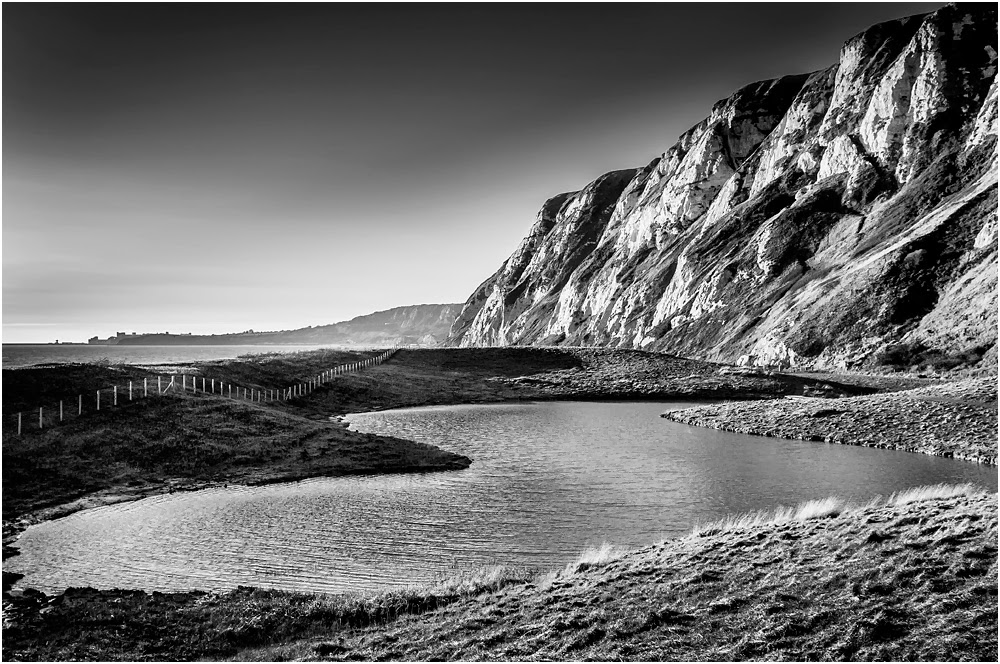
We decide on Samphire Hoe; a place created from the spoils of digging the channel tunnel (from England to France), and it is the famous White Cliffs of Dover that dominate the skyline in the photograph. As is traditional, many people emerge from the excess of the Yuletide season today in an attempt to burn-off all those extra calories (you wish), and the car park is almost full upon our arrival. Despite this, the area is large enough to absorb the multitudes effectively enough to keep them out of shot, and preserve the wild and desolate feel of the place.

Amongst other things that Nic gave me for Christmas, were two books; both featuring photographers known for their black and white images. Shadow and Light by Bill Brandt, and the other titled: Ansel Adams - 400 Photographs. Just the thing to stir those creative juices, and getting myself inspired during the long winter nights.


24-70mm f/2.8G AF-S Nikkor. 1/800 second at f/5.6. ISO 320


© 2013

Wednesday, December 11, 2013

11/12/13...

The last of the consecutive dates of the century - you had yours a month ago, America - and I plan to shoot something to mark the occasion. I had planned to take a photograph at nine minutes past ten this morning, but that idea fizzled-out shortly after I woke, purely because I had no location in mind.

Instead, I set off to the river with a selection of lenses to see if anything suggested itself as a subject. I stopped at a pond that I used a year ago to take images of leaves, and made a number of exposures before deciding to move on and try my luck further upstream.

As I'm riding towards a local weir on the Dorset Stour I am inspired by an idea that comes out of nowhere; to photograph a heron with a long exposure. It had not, for one second, ever occurred to me that a strong ND filter would be of any use for wildlife shooting, but the possibilities of how it could be achieved soon became all to obvious to me. All I needed was the subject.

I am gladdened by the sight of said heron as I approach my chosen spot that runs adjacent to a golf course, and hope that it doesn't fly off the moment I arrive. It doesn't, but merely stands patiently awaiting its next meal. I have time to set up my tripod; frame; focus; note the exposure value and apply the filter factor to compensate for the loss of light; screw the filter on to the front of the lens and fire the shutter. Frankly, I can't believe my luck with it all; being able to get the images I had in mind within five minutes of my arrival.

The bird does move position several times, but I am able to reframe and shoot as it feeds, making a good many exposures to be sure I get what I'm after. The fact that a heron will stay motionless for long periods of time whilst it eyes-up its prey is the key factor for getting shots like these, as the slightest movement ruins the image. I am more than pleased with the purchase of the filter, and wish I had bought one a year ago when I first thought about it. So many missed photographs; so many to come.


300mm f/4D AF-S Nikkor. 2 seconds at f/8. ND 1000 filter. Tripod and remote release. Mirror lock up. ISO 400


© 2013

Monday, December 09, 2013

Having fun...

No doubt about it. This new filter is giving my photography a much needed boost and I'm having a lot of fun with it in the process. I never have been a big user of filters for photography, apart from the occasional grey graduated or polariser, but for this one I make the exception. I am hooked.


I am on a local beach during late afternoon, and the sea and sky are exactly what I wanted: calm and cloudless respectively. I make a number of long exposures as the sun dips to the horizon, but it is after it has disappeared altogether that I start to make the photographs I am here for.

I have always been struck by the colour contrasts of the sky and water once the sun has set, and I use this to great effect to produce a simple, yet striking, image.


24-70mm f/2.8G AF-S Nikkor. 80 seconds at f/11. ND 1000 filter. Tripod and remote release. ISO 200


© 2013

Saturday, December 07, 2013

Two bridges...


I'm going to have to watch myself with this new filter, as it might quickly become overdone. However, for the time being it will get as much use as I can put it to, so you will have to indulge me for a while yet.

All too often I bemoan the lack of good light when I want to shoot, but this filter has the opposite effect on me. I find myself hoping for grey, dull days and low light levels, so I can use long shutter speeds in the middle of the day, and not have to worry about stopping the lens down too much to help things along.

Today, I choose two local bridges as a subject. Both span the Dorset Stour at Iford; are 80 yards (73 metres) apart, and situated roughly three miles upstream before the river meets the Dorset Avon. Both rivers then empty into Christchurch harbour, and finally the sea. The old bridge is downstream from its more modern counterpart, and is a Grade II listed building. Originally built on the site of the fording point of the river, it dates from 1784 and built from Purbeck stone. The newer bridge carries the A35, and was opened in 1932.


12-24mm f/4G AF-S Nikkor.

Top: 50 seconds at f/11
Below: 45 seconds at f/11

ISO 200. ND 1000 filter. Tripod and remote release.


© 2013

Friday, December 06, 2013

Afterglow after sunset...

The storm that hit the northern parts of the UK didn't make it as far south as the forecasters said it would, although there was widespread flooding in low-lying areas due to the high tides that coincided with the storm front. Although the waters were higher than the storm of 1953 - which claimed hundreds of lives through drowning - the improved sea defences (as a result of the disaster), did their job admirably.

It was not clear if travel was going to be a good idea for my return trip, today, but the high winds never materialised in the southern counties, and the drive back to Dorset was not in any way a risk.

The sky looked good once I arrived home, and having checked the tide tables (a low one was due for early evening), I decide that an hour or so of late afternoon photography would be a nice way to round-off a very pleasant stay with Nic. The predicted low tide will occur in darkness, so I know I won't get the full effect, but all the same I hold off from making photographs until the sun has set. Once again the 10 stop ND filter is being used to create long shutter speeds, which makes the most of the afterglow. It only lasts for a few minutes, but I feel that I have what I came for. Lucky me.


12-24mm f/4G AF-S Nikkor. 60 seconds at f/11. ND1000 filter. Tripod and remote release.


© 2013


Wednesday, December 04, 2013

This time, Oare next...

I'm spending the week in Kent with Nic; drinking tea; eating cake and taking photographs. The UK is forecast to have storm conditions in the next 24 hours or so, with severe risk of flooding due to a coincidental tide surge, so we make the most of it while we can.

It has been overcast all day, but the cloud is expected to break during late afternoon. So, before we visit Oare Marshes for a photo shoot, we visit nearby Faversham for some of the aforementioned tea and cake (we had coffee, but it doesn't quite have the same ring).

The weather does its stuff as forecast (well done, The Met Office), and we are treated to beautiful light and a spectacular sunset across the marsh. There is plenty to point a lens at on the marshes, and one of these days I will make more of the numerous wrecks that litter Oare creek (below), but as they are unaccessible on foot due to the mud flats it will have to wait until I am carrying much longer lenses and a tripod.

Maybe next time.


12-24mm f/4G AF-S Nikkor

Top: 1/250 second at f/8. + 0.33 EV compensation. ISO 400
Below: 1/160 second at f/8. + 0.67 EV compensation. ISO 400


© 2013

Monday, December 02, 2013

The big stopper...

Every once in a while a photographer will add something to the arsenal of gadgets and lenses that takes image making to another level for him or her. It is almost a year to the day that I first thought about buying a "big stopper": a ND1000 neutral density filter and actually getting one. I'm glad I did.

Such filters are almost opaque, and they prevent 10 stops of light from getting through the lens and on to the sensor. Quite why anyone would want that might be a mystery to some. After all, it's all about the light, isn't it? Well, yes, but being able to control the amount to such a degree opens up all sorts of creative possibilities.
So, armed with this new gadget I set off to the local pier to learn how to use it.

It is a grey day - ideal for what I have in mind - although the leaden sky does break as soon as I arrive, but no matter. It will all add to the effect. It is very time consuming to shoot with such a device on the front of the lens since once it is attached nothing can be seen through the viewfinder, and I have to unscrew it every time I change composition. Still, no bad thing as it slows me down and allows me to work in a more thoughtful way. Of course, a tripod is a must with this type of shooting.

Everything has to be done in manual mode - from meter reading to focusing - then the necessary filter factor applied to get a good exposure. Despite all that light being prevented from getting into the lens I am still forced to stop down the lens much further than I would like, due to diffraction, but for today's purposes I will let it go.

For a first attempt I was rather pleased with the results, and coupled with my renewed interest in monochrome imaging it has opened up new horizons for my photography. Which, let's face it, can be no bad thing.


12-24mm f/4G AF-S Nikkor.

Top: 16 seconds at f/22. ISO 160
Right: 50 seconds at f/22. ISO 200

Manual focus and metering. Exposures timed by my watch. Tripod and remote release. Mirror lockup in bulb mode.


© 2013