Gallery

Thursday, February 02, 2012

Ice and sand ripples...


Not content with this morning's cold start I venture out again in the afternoon as temperatures soar to 1º C and head for the southern shore of Christchurch harbour. Upon arrival I'm mildly surprised to find that the water's edge has frozen (left). This, no doubt, is due to the fact that two rivers empty into the harbour: the Avon and the Stour, contributing to the low salt content despite the fact that it is tidal. Christchurch Priory can be seen perched on the horizon.


Following this I wander on to nearby
Mudeford Spit (pronounced Muddy-ford) to photograph the
windswept beach. I'm looking for shape and texture here, and I find it in abundance. One advantage of such a cold day, despite all the sunshine, is the fact that the area is deserted, and the wind-formed patterns have not been disturbed by others. The low afternoon light throws the ripples into relief, and I have already decided to produce monochrome images from the results.

Both images: 24-70mm f/2.8 AF-S Nikkor
Top: 1/500 second at f/11. ISO 400
Right: 1/2650 second at f/11. + 0.33 EV compensation. ISO 400


© 2012


Winter dawns, frozen derailleurs and the beginning of the end...

The cold snap continues over much of the UK, and I'm up well before dawn to inspect the sky. The Met Office and I concur: it's clear. I set off into the approaching dawn and an Easterly wind - eyes watering from the cold - and head to the beach.

I arrive in good time and pull my camera out of its bag. I'm immediately greeted with a low battery warning in the viewfinder: low temperatures take their significant toll on such items, but I should be okay as my reserve battery still reads 69%. After all, I won't be hanging around once I've got what I'm after. Low temperatures are beginning to take a toll on me, too.

On Southbourne beach, Poole Bay, the sun makes its appearance at 7.45am and I start making photographs. Although low tide is not for several hours I've managed to find a tidal pool on the sea shore that I can use as foreground interest (an old architectural design trick - it instills a calmness), and I click away for seven minutes until the sun has climbed above the cloud and the effect has gone. Shoot over.

In that short duration I've noticed the cold for the first time, despite wearing numerous layers of thermal clothing. It started me thinking: this may well be the last winter I shoot at this time of the day. This thought is compounded by the fact that both derailleurs on my bike have frozen, and I'm restricted as to what gears I can use. This, no doubt, it due to the fact that I hosed-down the bike yesterday to remove two days of accumulated mud from riding across nature reserves, and the fact that water still remained in the linkages.

So, for the first time I'm considering being more selective with shooting at certain times of the year. That, plus the fact that lugging heavy glass around is beginning to take its toll. Time to think about selling up and finding something lighter.


24-70mm f/2.8 AF-S Nikkor. 1/160 second at f/11. + 0.67 EV compensation. ISO 400


© 2012

Wednesday, February 01, 2012

Ducks on thin ice...

A total contrast to yesterday's weather: today we had blue sky, dry conditions and a stiff Easterly wind that gusted up to 30mph (48kmh), so it felt colder than it actually was.

But cold it was, anyway, with temperatures sufficiently low to freeze the surface of a local duck pond - not solid - but enough in places to require a Ferruginous Duck - and, indeed, other species - to scramble up onto the ice to allow it to get from one thawed-out spot to another in search of food. As graceful as ducks are on water, they are somewhat ungainly on land, and in particular, ice. Getting a grip, as it were, is not possible, so they slid from A to B on their bellies (photo).

I photographed waterfowl at this location last March, and as far as I can tell it is the same bird. Now, my reference book of British birds and waterfowl maintains that the featured species of duck is a rare visitor to the UK, with as few as 30 sightings a year recorded. Maybe this particular chap came to visit and decided to stay. Anyway it's in Throop, Dorset, if you want to have a look for yourself.


300mm f/2.8 AF-S VR Nikkor with TC-14EII converter. 1/1250 second at f/5.6. + 0.67 EV compensation. ISO 400. Monopod


© 2012

Tuesday, January 31, 2012

A winter's day and burnished bark...

By the time I get out of the house for some photography it has become a typical British winter's day: overcast, damp and cold. Temperatures hover at around freezing - evident as broken ice on puddles after recent rain remains frozen, and in some cases has frozen over a second time.

Despite this there is a stark indication that spring has been trying to happen - at least before the current cold snap - in the form of blooming daffodils at Throop, Dorset (right). I first mentioned this in my 7th January post, where the shoots were up but not in flower. I had intended to return earlier to photograph the openings, but what with one thing and another I never managed it until today. A remarkable occurrence for January, to say the least.

Having got my shot by sprawling on the ground (protected by a strategically positioned bin liner - I think of most eventualities), I move on to Stour Valley Local Nature Reserve via the Muscliff Arboretum, and my attention is immediately drawn to a fine example of a Tibetan Cherry tree (Prunus serrula). I have passed this tree numerous times, and why I have not noticed its distinctive bark before is beyond me. I ask a passer by if they can identify the tree, and I'm reliably told it is an acer, but according to the arboretum species listing it is, in fact, a cherry. I will be returning to this particular specimen, with its burnished bark, in the coming months.


Both images: 90mm f/2.8D EX Sigma macro lens.

Top: 1/320 second at f/5.6. - 0.33 EV compensation. ISO 400
Below: 1/320 second at f/6.3. + 0.33 EV compensation. ISO 500


© 2012

Monday, January 30, 2012

A bit of a gambol...

Winter has arrived, it seems, at least along the coast of Dorset. This is validated by low temperatures, an Easterly wind... and snow. Yes, something of a rare occurrence in the area, but at 9.37 this morning I witnessed falling flakes.  Albeit very slight, it would still be enough to make bookmakers acknowledge a white Christmas (had it, in fact, happened on that day - i.e., a payout). So, in a nutshell: today it snowed.

By early afternoon the thick grey cloud had thinned sufficiently to allow a bit of sun through, so I selected an unlikely lens pairing - an 85mm f/1.4  portrait lens, and a full frame fisheye - and get out on my bike to shoot seascape images.

I'm busy photographing waves breaking on the beach at Southbourne when a small short-haired, er... dog, gambols through the waves as they roll along the shore, barking at everything and nothing and clearly having a grand time of it all. By the time I fire the shutter I have already decided to convert the image to monochrome.


10.5mm f/2.8 fisheye Nikkor. 1/500 second at f/8. ISO 400


© 2012

Friday, January 27, 2012

A personal best...

My word, what a lot of weather we're having along the south coast at the moment - more like April showers than winter - but it does give me reason to go out again during late afternoon to see what can be had with a camera.

I'm no sooner riding along Bournemouth's sea front when I'm caught in one of the aforementioned showers and take shelter on Boscombe pier, where I photograph the rain coming down over the Isle of Purbeck. Unfortunately, the pier closes at 4pm at this time of year, so I'm ejected before the gates are locked.

I make my way west before eventually stopping to photograph the last of the afternoon light at Branksome Beach. I'm carrying a fisheye lens with me on this occasion - not the land or sea-scapers first choice of optic -  but occasionally it comes in handy for something a bit different, with its 180º angle of view from corner to corner, and huge depth of field. At least I don't have to worry about level horizons, and straight lines are out of the window, so it's a fun lens to use with the right subjects.

I also think I've made something of a record for this blog, today: 14 posts in a month (and still four days to go).


10.5 mm f/2.8G Fisheye Nikkor. 1/320 second at f/11. - 0.67 EV compensation. ISO 400


© 2012

Halfway to France...

An early morning check of the Met Office's Infrared satellite image tells me all I need to know: clear skies over much of England. That, plus light winds, and it's a recipe for a pre-dawn start for some early morning exercise and photography thrown in along the way, should anything present itself to the camera.

On such ventures it is always my policy to ride into the wind on the outward leg of the trip - it's so much nicer (and easier) to have it on my back going home - so I again cycle west along the front of Poole bay as the dawn begins to break. Sunrise is at 7.50am, but I won't see that due to the cloud bank that so often sits on the horizon (in the photo it is roughly half way across the English Channel), but I start making photographs the moment I arrive at a favourite spot on the beach of Canford Cliffs.

I shoot a number of images into the light as the sun breaks above the cloud, but it's the delicate pastel hues of the early morning light that produces the best image, with Handfast Point and Old Harry Rocks on the horizon.


24-70mm f/2.8 AF-S Nikkor. 1/320 second at f/8. ISO 400


© 2012

Thursday, January 26, 2012

Shower clouds and meteorological phenomena...


For once the Met Office's weather forecast was accurate. Hyperbole, of course - we all like to moan about how far out the weather forecast is almost as much as we like to moan about the weather - but today I experienced the full gamut of its prediction.

So, heading into a brisk Westerly wind I arrive at Sandbanks, Poole, as the tide is going out. There are a few kite surfers doing their stuff on the water - and I do mine - with the obligatory shots that I know I'll never use. Even with this in mind it serves as a warm up: to get my eye in and look for images or situations to photograph - getting in the mood, if you like. Ordinarily, these frames languish on one of several hard drives, never to see the light of day again, but earlier this week I executed a pretty severe edit of such images dating back to August of last year, and consigned 2283 RAW files to the trash.

It's as I'm half-heartedly shooting the kite surfers that shower clouds roll in and darken the sky, and rain is visible in the far distance. This is only temporary, because no sooner has the cloud moved directly overhead the horizon begins to lighten. Straight away I know there will be a rainbow to shoot, so I start looking for a suitable scene to capture the event.

The rain itself bypasses me, and I am able to capture the optical phenomenon over the sea, as well as part of the shower system that caused it.


18-35mm f3.5-4.5 ED Nikkor. 1/1250 second at f/8. - 0.33 EV compensation. ISO 560


© 2012

Sunday, January 22, 2012

Dustpan and Brush...

The last in the current trilogy of this weekend's sunset photographs (I hope: well it has to be since today is Sunday). I'm finding precious little to shoot at the moment, but with early signs of spring being just around the corner I'm content to make do with the easy subjects.

It had been a mostly clear day along the coast of Dorset, although a gusty wind took the edge of it, but as mid afternoon arrived wispy, high-altitude cloud rolled in. However, not enough of it to rob me of the light.

Low tide in Poole Bay was at 1600 hours, so I venture to the beach for dusk images, plus the hope that again I might be treated to an afterglow and something dramatic. Not so this time, although the sky had good detail once the sun had set (right).

In spite of low water I'm forced to keep an eye out for waves that continually roll up the beach and threaten to engulf my feet - past experience has conditioned me to this - whilst I try to capture wave patterns that in some way echo sky.

Oh, yes, the blog title: I did it for a dare! (don't ask).

12-24mm AF-S Nikkor. 1/400 second at f/5.6. ISO 640


© 2012

Friday, January 20, 2012

f/8 and be there...


f/8 and be there: the mantra of the press photographer - set the lens aperture to that value and let what's happening in front of you do the rest. Wise words, indeed, if you have a subject to photograph, but it's another drab day, light wise, and another late start before the weather gets interesting. With less than an hour to go before sunset I set out on my bike, chasing the light.

The cloud has broken sufficiently, and experience tells me that I may not only get a sunset to photograph, but also an afterglow - more photogenic in my book. This does not always happen once the sun dips below the horizon, but it's always worth waiting to see if it happens before packing up and leaving the scene.

Today it does. I select the widest lens in my bag, and keeping a wary eye on an incoming tide I go down on one knee to get a lower angle. I start making photographs as soon as the sun disappears from view and watch keenly as the strength of the colours on the clouds intensifies. I have to be vigilant and shoot at the peak as the colours are at their strongest for only a minute or so: after that they weaken and fade and the shoot is over.


12-24mm f/4 AF-S Nikkor. 1/100 second at f/8. + 0.33 EV compensation. ISO 800


© 2012

Thursday, January 19, 2012

Deliberate flare...

Today almost didn't happen. After yesterday's shoot under heavily overcast skies I decided not to venture into the great outdoors as it was a similar kind of day: heavily overcast. The weather forecast hinted at brighter conditions as the day wore on, but I ignored it.

By mid day the light had not changed a bit. By mid afternoon it looked like it might rain. Then it did. But a quick perusal of the Met Office's satellite photo suggest clear conditions would shortly follow.

It was late in the day when I finally decided to risk it, and cycled down to the seafront at Boscombe, on Poole Bay to catch the last of the light. I arrive as it starts raining again, but not deterred I stand on the shore line and start taking photographs in the rain as the sun sets.

Keeping the front element of the lens dry is impossible in spite of a lens hood (use one at all times, folks), and after several attempts to remove the rain drops I give up and shoot away, allowing the droplets to produce flare in the image - an effect that contributes to the feel of the image.

24-70mm f/2.8 AF-S Nikkor. 1/30 second at f/8. + 0.33 EV compensation. ISO 400


© 2012

Wednesday, January 18, 2012

Frame within a frame...

The high pressure weather system that was briefly positioned over the UK has since drifted east across Europe, and the skies have become heavily overcast: time for some photography.

Initially, I spend some time shooting details in the sand exposed by a retreating tide in Poole Harbour before moving on to fisherman's dock, where I spend a good forty five minutes attempting to produce an image with a strategically placed gull to complete the composition. All to no avail. It's here that I have a brief discussion - and a different perspective - with another photographer that happens along. We nod to each other in acknowledgement of the cameras we are holding before I speak: "Great light, isn't it?" I say. Clearly mistaking my enthusiasm for sarcasm, he replies: "Terrible, isn't it?"

We are both looking for different things, and both equally valid.

I give up with the gulls and wander onto Poole Quay to see what catches my eye, and it's a window on the corner of Custom House, situated on the quay itself, and the warmth of the scene within that produces today's photograph. However, it's the weather-worn wooden frame that gets my scrutiny, and I select a medium-wide aperture to throw the interior out of focus, and use the wooden arch to produce a frame within a frame, allowing the reflections of the scene behind me to complete the picture.


50mm f/1.8D AF Nikkor. 1/250 second at f/4. - 0.33 EV compensation. ISO 640


© 2012

Monday, January 16, 2012

Crafty little trick...

Having edited and processed this morning's images I check out the weather forecast and realise that the current high pressure is not going to last, and rain is expected mid-week. So it's back on the bike during mid afternoon to make the most of what's on offer.

I cycle to Christchurch harbour, Dorset, with something specific in mind: photographing the local priory from the top of the headland that forms the southern shore - Hengistbury Head. I make a number of images as the sun dips down, but it's not coming together for my taste and I give up on the idea and cycle along the seafront towards Boscombe, keeping an eye out for anything of interest.

The sun has been set some twenty five minutes before I come across the scene here. There is a good afterglow in the cloudless sky, and the sea has turned blue due to the high colour temperature. I decide to photograph the effect. This is the tricky bit.

Most camera meters will try their best to give you an overall balanced exposure under such conditions, but the end result is often too light and unrealistic. This is not what I'm actually seeing. To regain the tones of the scene before me I use a crafty little trick: set the exposure compensation to -2 stops; in other words, force the camera to underexpose by two full f/stops below what it wants to give me. This will produce an exposure far closer to what is actually in front of my lens. Now, this works with Nikon camera bodies in Matrix metering mode. Whether it works in the same way with other makes is unknown to me, but it is something worth considering when faced with pre-dawn or dusk scenes.


300mm f/2.8 AF-S VR Nikkor (VR on) with TC-14EII converter. 1/60 second at f/4. -2 stops EV compensation. ISO 800. Monopod

A life form and its star...

High pressure over much of the UK during the past day or so has resulted in a few of those special winter's days of clear blue skies and cold, bright conditions: time I took advantage of some early light.

I'm up well before dawn, and a swift look outside reveals stars in the sky. It's clear. I decide upon a super telephoto lens to (hopefully) capture the sunrise over the sea, but until I arrive at my chosen location I'm never sure if I have the right choice of optic(s) slung over my shoulder - there can be a distant cloud bank that so often lurks low on the horizon, which not visible from where I live.

I arrive at Southbourne cliffs in the pre-dawn and immediately know I have chosen wisely. No cloud! I make my way down to the beach; set up my camera on a monopod...and wait. I have fifteen minutes or so before the sun is due over the horizon at 8.04, so I spend the time photographing the half moon and making test exposures. I'm trying to anticipate how much exposure compensation to give my basic meter reading, but dial in a plus value as a starting point as I am shooting into the light. I will make adjustments on the fly.

The sun's disc becomes visible at the expected time and I start making photographs. All well and good, but I always feel that scenes like this need a little something extra, and I've taken to habitually using gulls to achieve this. Always a hit or miss technique, but again an obliging bird sails into the frame before the sun becomes too bright and the shoot is over.

300mm f/2.8 AF-S Nikkor with TC-14EII converter. 1/1600 sec at f/5. + 0.33 EV compensation. ISO 400. Monopod.


© 2012

Friday, January 13, 2012

Friday 13th...


Well I ain't superstitious, sang Howlin' Wolf in 1961, and no black cat crossed my trail either, but for a moment the bad luck associated with the above day and date seemed to be playing a hand in the afternoon's proceedings. Having prepared my camera gear and dressed appropriately in thermal everything - maximum temperatures are expected to peak at 6ºC - my final check before leaving the house was the tyre pressures on my bike. It was at this point I thought things were beginning to work against me.

The dust cap on the rear wheel valve was somewhat recalcitrant as I tried to remove it for tyre inflation, but when it finally did yield it also took the valve itself with it as it came free. Nil desperandum: I simply replaced the tube with a fresh one and set off along the coast.

I make a number of stops for photographing whatever takes my fancy along the seafront of Poole Bay, Dorset, but it's the Twin Sails lifting bridge in Poole itself that really gets my interest, set against the winter sky. The bridge was slated to be opened this month, but from what I can glean that won't happen now until early March (the 9th was mentioned in conversation with a fellow snapper), but I'm lucky enough to be treated to a test closure shortly after I arrive (top).


Satisfied I had something of worth, I pack up and head home, but as I cycle along the edge of Parkstone bay it is evident there will be a sunset worth pointing a lens at, so I stop to make a number of exposures with a telephoto zoom lens as the sun dips below the distant hills of the Isle of Purbeck. The lone silhouette of a gull skimming the surface of the water makes the shot. Another successful image, the shooting location of which can be found below.

So, despite a slightly ominous start to today's outing things turned out rather well, dispelling the myth of the unlucky date. Of course, as they say in America: your mileage may vary.


Top: 24-70mm f/2.8 AF-S Nikkor. 1/80 second at f/9. - 0.33 EV compensation. Polariser. ISO 400
Below: 70-200mm f/2.8D EX Apo Sigma lens. 1/640 at f/9.  + 1.33EV compensation. ISO 200


© 2012

Saturday, January 07, 2012

Reserved cormorants...

After the (somewhat) recent blustery weather the weekend starts calm and clear, and I make my first visit for some months to the Stour Valley Local Nature Reserve, Dorset. I ride the entire length of the reserve, keeping an eye out for anything interesting (there are otters afoot, they say), but apart from emerging willow catkins there is little to point my lens at.

The area is largely deserted, apart from the odd fisherman along the river bank - surprising since it's a Saturday and the weather is bright - but it's the more expert variety that eventually gets my attention at the North west corner of the reserve. I stop to photograph electricity pylons reflected in the water (left), and notice several cormorants perched high up and drying themselves in the winter sunshine.

I switch lenses for the longest optic in my bag (why do I always have the big stuff at home when need it the most?) and zoom in to capture the scene in greater detail.


I had noticed this particular perch almost a year ago when I first visited the nature reserve, but either the birds or the light was not present when I was, so this time I relatively lucky, super-telephoto lenses notwithstanding, and get some acceptable shots (right).

Although very much in the grip of winter - and much colder days are yet to come, I feel - there are some signs of spring; particularly at Throop, where daffodils are up but not as yet open.

Top: 24-70mm f/2.8 AF-S Nikkor. 1/100 second at f/11
Right: 70-200mm f/2.8D Apo Sigma lens. 1/800 second at f/5.6.
ISO 200


© 2012

Friday, January 06, 2012

Sodium vapour and moonlight...

It's way after dark before I decide to go out for a ride and a bit of photography, but having made the decision to travel as lightly as possible I decide against using a tripod and elect to shoot with available light.

I have six fast aperture lenses - the fastest being f/1.4, but on this occasion I dig out a little used lens that I bought some years ago when I still shot with film. For some reason or other this particular optic fell out of favour and it was high time it got some exercise.

I'm cycling along the seafront of Bournemouth, keeping an eye out for potential subjects, when my progress is eventually arrested by the buildup of wind-blown sand on the promenade: it's too deep to ride through. I push the bike for a hundred metres or so and take a number of photographs of a refreshment kiosk (long closed for the day: maybe the winter), but it's the scene behind me that produces a spark of creativity.

Light levels are very low, and despite the fact that I'm shooting with the lens wide open shutter speeds are appallingly low for hand held photography. The fact that I'm using a wide angle lens helps enormously to achieve a sharp image at such slow speeds, but I have to be careful with technique.  My only real option is to rack-up the ISO to get something manageable. Now, the camera I am using is ancient technology in digital terms (5 years old) and huge progress has been made since those days in digital sensor arrays, and no doubt modern cameras would leave mine standing with high ISO settings, but I have little choice. Digital noise will be a problem.

Contrast is through the roof, so I switch to manual and take a spot meter reading from the sand beneath the light, and add a further 1⅓ stop exposure to my settings to stop the beach recording as a mid grey. I let the lamp burn out in the image. I also decide to leave the ghosting created by the lens as it adds to the atmosphere. I do attempt to correct the colour balance from the orange glow of the sodium vapour lamps used to illuminate the beach front after dark, but because it is a discontinuous spectrum it is not possible for a full correction. I thought you would like to know that.


20mm f/1.8 D EX DG Sigma lens. 1/20 second at f/1.8. ISO 2500


© 2012

Thursday, January 05, 2012

Shadow and sand...

Strong winds and rain have been a feature of the UK's South West over the past few days, causing damage to nature and property, but today there was a break in the cloud, leaving blue skies to shoot under. However, the winds remained, gusting up to 45mph (72kmh) along the coast.

Under such conditions I nearly always opt to visit the seaside for photography, but despite the wind there is no sea running, so no chance of dramatic images. Instead, I concentrate on wind-blown sand patterns and shadows as here on the seafront at Southbourne in Poole bay.

Travelling light with only one lens - as I was today - is always going to be a compromise: the photographer can rest assured that in the case of toting a single optic such as a wide angle lens then a telephoto would be more suitable, and vice versa. This time I had chosen a wide angle zoom lens for flexibility, but my eye was seeing detail that ideally required a 50mm lens (or short telephoto) to capture the effect I was after. As a result I have to adjust my eye and look for the bigger composition, however mundane. Fortunately the ripples in the sand and shadows thrown across it help make the foreground interesting.


12-24mm AF-S F/4 Nikkor. 1/200 second at f/11. - 0.33 EV compensation. ISO 200

© 2012

Monday, January 02, 2012

Obliging gull...


The first decent light of the new year and I'm out on my bike for some photography. In fact it's a crisp winter's day with a stiff breeze, and conditions are ideal for water sports, so I head for Poole Harbour to see if there is any action. There is, of course, plenty to photograph, but I have numerous shots of kite and wind surfers and today I'm just not inspired.

The sky had remained a cloudless blue for most of the day, but during mid afternoon clouds roll in from the Southwest and the sky suddenly becomes more interesting than those rubber-clad figures scooting along in the middle distance. I change lenses and start photographing the cloud formations. Interesting as they are, ideally need something as a focal point. I keep making exposures until a gull obligingly flies into position to complete the composition. At that point I know I've got the shot I'm after.

The shower clouds disappear almost as quickly as they arrived, but by that time the light - and the water sports enthusiasts - have gone; closely followed by me.


24-70mm f/2.8G AF-S Nikkor. 1/800 second at f/8. + 0.33 EV compensation. ISO 400


© 2012

Tuesday, December 27, 2011

Night lights...

Basing today's plans on yesterday's weather forecast turned out to be a mistake (so what's new?) and I postpone my trip for some photography on the Isle of Purbeck, Dorset. However, not being deterred by the Met Office's unspecified grey cloud that blankets the area, I get on my bike, camera over my shoulder, and ride the seafront of Poole bay in search of alternative subjects.

I make a number of attempts at photographing ducks and geese in Poole Park, shooting by holding the camera at ground level and essentially shooting blind. Always a hit or miss technique, and on this occasion the latter prevails and I get nothing of any value: only out of focus images of very poorly framed birds.

It's on my way home that I arrive at the approach to Bournemouth pier, and initially attracted to the fairground lights reflected in the old Waterfront building, but finally opt for photographing one of the rides in operation. There is still enough light to give the sky some detail, but it is essentially a hand-held night shot. Because of this I am forced to shoot with the lens wide open and a higher ISO than I would have liked, but timing the swing of the ride and shooting when it is at its highest helps to keep things sharp.

24-70mm f/2.8G AF-S Nikkor. 1/125 second at f/2.8. - 0.67 EV compensation. ISO 1600


© 2011

Sunday, December 18, 2011

Can you see a difference?

Whilst out shooting yesterday afternoon, I had the presence of mind to take a couple of comparison shots of a scene I was working on with my mobile phone camera. I've never done this before, but wanted to know how the results would compare to that of professional camera equipment.

Now, I wouldn't be surprised if my phone camera had all sorts of exposure and zoom capabilities built in, but since I don't intend to use it in any serious capacity I've not bothered to find out what these are (if any). In this respect it is not a fair comparison as the focal lengths are not the same (nor the resolutions in the way of a pixel count) - and heaven knows what the focal length of the tiny piece of glass(?) and sensor dimensions are - but I just wanted to find out what sort of quality I could expect.

I gave the original file a tweak in Adobe Photoshop before resizing it to be used here, and although the native file would only print at 8.5 x 6.5 inches (21.6 x 16.5 cm) compared to the 18 x 12 inch (45.7 x 30.5 cm) RAW file of my Nikon body, I find the phone to be a useful tool as a photographic notebook.

I have no doubt the phone camera images print well in the sizes it is intended for, and reproduces well enough on a web site such as this, but since I carry it with me everywhere I go it may well prove it's worth one day. After all: an image is better than no image.

(no metadata available)


© 2011

Saturday, December 17, 2011

Here come ol' flat top...

It's way past noon and I'm still indoors, having a chat with my best friend about photography and the possibilities of what to photograph. The agreed theme for the afternoon's shoot eventually becomes "take a photo of nothing". Almost as soon as it is agreed I have at least one idea enter my head as to what that might be. The final outcome is anything but.

The exercise is to have a walking meditation with a camera over my shoulder, although I bend the rules a bit (well, quite a bit, actually) and take my bike instead. I did stick to the other part of the deal, however, and took just a single prime lens for the afternoon's shoot.

I start in a local park, photographing pine cones and fallen leaves on the grass, but soon find myself on the cliff top of Poole Bay, Dorset, and become fascinated with a distant storm cloud, seen here apparently positioned over the Isle of Wight on the horizon. The warm air rising in the cloud eventually creates the characteristic flat top, which can be estimated at around 36,000 feet  (7 miles/11km), as it reaches the tropopause, between the stratosphere and the colder air of the troposphere. There, I said it.


50mm f/1.8 AF Nikkor. 1/125 second at f/11. - 0.67 EV compensation. ISO 200


© 2011

Tuesday, December 13, 2011

Blue skies and sooty-grey...


After last night's strong winds and heavy rain the day breaks clear and calm, and I have the idea to visit a location that I've not been to for over a year for some waterfowl photography. My camera bag is already loaded with a super-telephoto lens and body, so it's just a case of dressing appropriately (thermal everything) and get into the car and drive.

As I head to Eyeworth Pond in the New Forest it occurs to me that this is probably the first time I've driven anywhere since October, as I mainly use a bicycle to get to the nearer destinations, these days. It starts to rain on the way, but it's only showers and I remain confident of getting something useful.

Upon arrival I find I have the place to myself, but as I start to set up my gear I discover that in my haste to leave home I've forgotten an important part of my photographic kit: the quick release plate for the ball and socket head on my monopod. It normally remains permanently attached to the foot of my 300mm lens, but I removed it in favour of the geared tripod head when shooting the moon last week, and never replaced it. Of course it won't mount and I have no option but to hand hold the camera. This is only a problem during extended shoots due to the weight, but the light is good and the sky is blue, so I just stand and wait.

There is the usual selection of ducks and drakes on the pond, as well as a cormorant, much to my surprise, but it's the coots, with their red eyes and distinctive white shield that get my attention on this visit. Although they appear black at first glance their plumage is in fact a sooty-grey, that can be seen in the photograph. The water ripples catch the sunlight and add some fill-in light to the feathers, highlighting their true colour.


300mm f/2.8 AF-S VR Nikkor with TC-14EII converter. 1/1250 second at f/4.5. - 0.33 EV compensation. ISO 500


© 2011

Saturday, December 10, 2011

Full, but not eclipsed...

As mentioned in yesterday's post, tonight it is full moon. Not only that, but there is a total eclipse of the Moon, although unless you live in the Shetland Islands in the UK it would not have been visible as such.

As it is, I'm thwarted by cloud cover by early evening from a photographic standpoint, and I resign myself to getting no shots of even a partially eclipsed disc in the sky.

I'm chatting with a friend on Skype in the late afternoon and making regular checks of the sky in the hope that something may appear. It's during one such visit outdoors that I see the cloud has broken sufficiently to get something on camera, so I hastily set up on a tripod and start making exposures.

Unlike yesterday, when I was able to expose solely for the Moon's disc, this time I have to compromise detail if I want to record the amazing cloud formation that contributes so much to the image. It's just not possible to record both within the latitude of a digital sensor or film. Something had to go.

300mm f/2.8 AF-S VR Nikkor with TC-14EII converter. 1/80 second at f/5. ISO 400. Tripod and remote release. Mirror lockup. Time: 17.26


© 2011

Friday, December 09, 2011

I see the Moon...


Over the past month or so I've freely given out information on Facebook and via Skype, to those that have asked, of how to photograph the Moon. I start with all the usual advice of: use a tripod, a remote release (or the camera's self timer) and to focus and expose manually, but it occurred to me, as I stepped out of the house and spied Earth's satellite: damn it, man, can you actually do it yourself?

It's been some time since I've made any serious attempt so I thought it was about time I brushed up on the technique. Now, the moon is brighter than most people think, especially now that it is nearly full (that occurs tomorrow) so pretty fast shutter speeds can be employed to help capture sharp images under high magnifications.

One other invaluable tip I can offer is to use the mirror lockup feature if your camera has one (we are generally talking SLR bodies, here). Once that is up and out of the way a few moments can be allowed for all vibrations to die down before the shutter is fired. Despite advanced damping engineered into modern camera bodies, the mirror is still capable of taking the edge off images such as these as it clatters up before the shutter blinds open. Some camera bodies also cause the mirror to be locked up when the self timer is activated, but I prefer to judge the exact moment of exposure myself.


300mm f/2.8 AF-S VR Nikkor with TC-14EII converter. 1/800 second at f/6.3. ISO 320. Tripod and remote release. Mirror locked up. Time: 16.46 GMT


© 2011

Cloud shadows...


At one time I would have set the alarm clock for early starts, but these days I appear to leave it purely to chance that I will wake up before dawn to go out for some early morning shooting. Mind you, there haven't been too may good opportunities for good light of late, so I don't feel I have missed anything.

This morning it is cold. Cold enough to wear thermal underwear, but I don't. I'm only intending to stay until the sun breaks the horizon, but a distant cloud bank scuppers that idea. Even so, I needed those thermals.

I spend around 50 minutes shooting aircraft contrails, dog walkers and passing birds as the light becomes more and more interesting. The sun rose at 7.56am, but it's some 30 minutes later before I shoot the image of shadows cast upon the sky by the clouds.

I do wish I had worn those thermals.

70-200mmf/2.8 Apo Sigma lens. 1/5000 second at f/5.6. ISO 640


© 2011

Saturday, December 03, 2011

Silver sea...


The weather forecast for today was way off. Overcast with some rain was predicted, but by early morning the clouds had rolled away and blue skies prevailed.

It was mid afternoon before I ventured out with a camera, and once again I chose the seaside for my shooting location. I could have (and did) make all the usual shots of walkers on the surf line, or cloud formations, but just before the sun dipped down behind a cloud bank to the West, I took a series of photographs which I knew I would convert to black and white as I fired the shutter. Pointing the lens into the light produced a high contrast mono image. Just the way I like 'em.

70-200mm f/2.8 Apo Sigma lens. 1/800 second at f/8. + 1 stop EV compensation. ISO 400


© 2011

Friday, December 02, 2011

December dawn...

A pre-dawn inspection of the sky from my bedroom window confirms yesterday's weather forecast: it's clear. It takes me just a few moments to pack my camera bag with two lenses, have breakfast and cycle to the beach at Southbourne, Bournemouth, and photograph the sunrise.

Conditions are near perfect and couldn't be more different to the corresponding day last year at the same location. The sun rises at 7.47am and I start making photographs. I'm lucky this morning as the cloud bank near the horizon allows me to shoot the sun as it appears over the sea, then shortly after gives me a sunburst from behind the cloud while it is still low in the sky.


70-200mm f/2.8 Apo Sigma lens. 1/200 second at f/11. + 0.33 EV compensation. ISO 400

© 2011

Sunday, November 27, 2011

Kites and herring gulls...


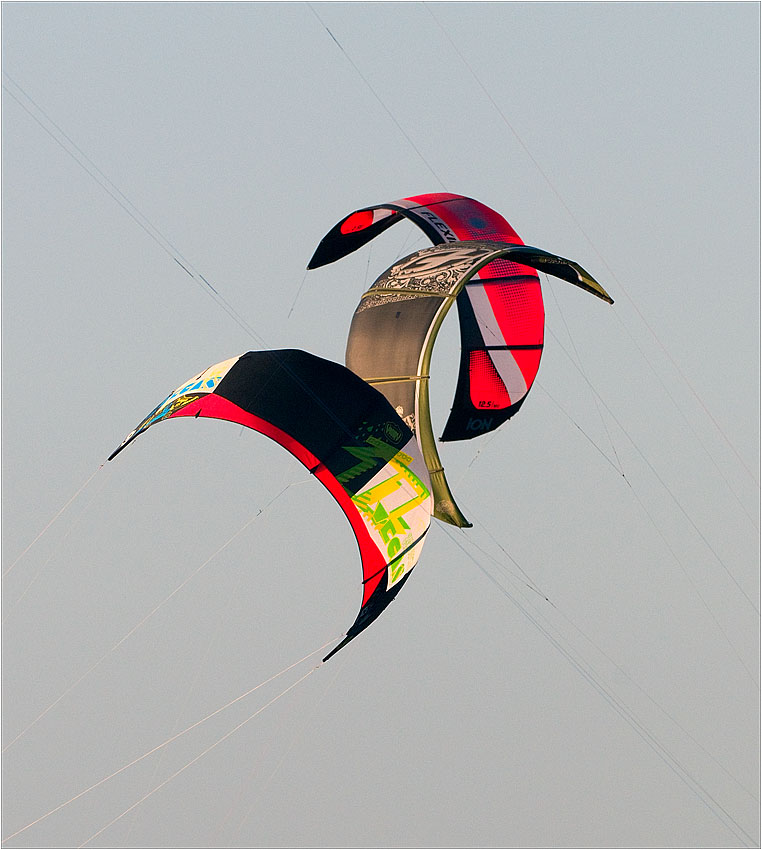
The heavy cloud of early morning gives way to blue skies and crisp autumn weather. A brisk westerly wind is blowing, and I know conditions are right for the kite surfing enthusiast, so I pack my longest lens and cycle to Sandbanks, on the southern shore of Poole Harbour. Despite the fact that I'm already shooting with a tele-converter attached to a 300mm lens the surfers themselves are too far from the shore to get frame filling images, so I opt to shoot the kites themselves (above).

Having stood for more than an hour in one spot the wind chill gets the better of me and I decide to head home - a bit of exercise will soon warm me up. As the sun sinks low on the horizon I come across a herring gull perched on a groyne head.


Normal procedure in this scenario is: I edge carefully towards my subject, making no sudden moves, slowly and quietly unpack my camera with telephoto lens attached, fix the assembly to the monopod and begin to frame the subject... at which point it flies off before I can make an exposure. Except in this case it didn't happen. The gull was more than happy (it seems) to be photographed on Bournemouth beach in the late afternoon sun.


Both images: 300mm f/2.8 AF-S VR Nikkor with TC-14E converter.

Top: 1/1000 second at f/8. - 0.33 EV compensation.
Below: 1/800 second at f/4.5
ISO 400

© 2011

Thursday, November 24, 2011

Arctic Sunrise...


I have a feeling the mild weather we have been experiencing in the South West of the UK is about to depart for cooler conditions, although the wind chill factor from a stiff south-westerly no doubt played a part, today.

I cycled to Poole Harbour, mainly for the exercise, but as always, I had my camera with me. Upon arrival at Sandbanks I was aware of the Greenpeace ship Arctic Sunrise leaving port, and I had to race it to the harbour entrance to get into position to photograph the vessel as it passed before Brownsea Island (photo). I had no inkling that the ship was in port, but obviously others did as there were more photographers than usual toting cameras in the area.

70-200mm f/2.8 AF Apo Sigma lens. 1/500 second at f/5.6. - 0.33 EV compensation. ISO 400


© 2011

Saturday, November 19, 2011

Rim light and motion blur...

The relatively mild weather of southwest England continues, and according to one dog walker I spoke to on Stanpit Marsh, Dorset, it's set to continue until at least the end of the month. I had arrived on the marsh during mid afternoon with my longest lens, but no real idea of what I intended to shoot. I took a number of "warm-up" shots before coming across the same chap who I bumped into a couple of weeks ago, counting the ponies. I ask him if he is still to arrive at a consistent count, but he tells me that he counts them every Saturday. He also tells me that a Glossy Ibis is still on the marsh and directs me to the general area.

He is, of course, right, but the bird remains tantalisingly out of range of my longest lens, even with a teleconverter attached. It's while I wait for the ibis to move closer (it never does) I turn and see a lone marsh pony - rim lit, along with the reeds - against the setting sun.


Once the sun dips below the horizon I decide to call it a day. I chat for a while with someone out walking and taking the crisp evening air, but it is just as we are both about to leave that a skein of Canada Geese appear from the North. I instinctively raise the camera to my eye and make a number of exposures as I follow their flight. In my haste I failed to make appropriate camera settings, and shot hand held with a shutter speed that was far too low to get sharp images. Not deterred, I open the files on my computer and find that some of these images have a pleasing blur, giving the feeling of movement to the photograph. Sometimes an error can still produce a useable photograph.


Both images:
300mm f/2.8 AF-S VR Nikkor with TC-14E converter.
Top: 1/500 second at f/5. + 0.67 EV compensation. ISO 400
Bottom: 1/60 second at f/4.5. + 1 stop EV compensation. ISO 400


© 2011

Thursday, November 17, 2011

Green light...


Often seen, but never photographed by me, today I was lucky enough to witness military training at Sandbanks, Dorset. I first spotted the Lockheed C-130 Hercules transport plane circling overhead from Bournemouth pier as I was out for an afternoon ride. I took a few token shots from a distance, and without a second thought carried on my way west. It wasn't until I arrived at the western end of Poole bay some 20 minutes later that I realised the aircraft was still in the area; still circling.

I began to make a series of photographs as the plane made a number of passes in the hope that its contents were still onboard, but despite the aircraft's main door being open there was nothing forthcoming. Finally, the Hercules disappeared into the distance, so I spent time making attempts to photograph gulls in flight.

Around 35 minutes later, to my surprise, it returned and continued the same flight pattern that I had witnessed earlier. Nevertheless, I kept a watchful eye on the plane, and was eventually rewarded with what I had been waiting for. The photograph shows a number of British Army Marines on a training exercise, jumping from the rear of the aircraft and parachuting into the sea near Old Harry Rocks on the Dorset coast.


300mm f/2.8 AF-S VR Nikkor with TC-14E converter. 1/2000 second at f/8. - 0.33 EV compensation. ISO 400

© 2011

Saturday, November 12, 2011

Unseasonably warm...


It remains unseasonably warm in the south west of the UK, and following orders I get myself out of the house with a camera and two lenses - both zooms (the lenses were my decision) - and go for an 18 mile bike ride. It was never my intention to ride that distance, but it was easy riding and the weather was good. It just happened.

I rode the full length of Poole Bay, Dorset, to start with, taking a number of images of Hengistbury Head at the Eastern end to get me started. There was a good deal of haze and that, mixed with the autumn light, produced the top image. In essence I photographed the light, not the subject.

Upon reaching the Sandbanks end of the bay I was attracted by a variety of gulls, squabbling over scraps of bread being fed to them. Their behaviour is predictable in this activity as they wheel overhead, waiting for their opportunity to swoop and grab what they can. This is where the telephoto zoom shines, as I can constantly reframe as the birds approach my position, shooting when they have in a good orientation to the camera. Prime lenses restrict this, often forcing me to shoot before the subject fills the frame, or sometimes too late, and part of the bird is lost out of frame.


Both photos: 70-200mm f/2.8 Apo Sigma lens.
           
         Top: 1/400 second at f/8. ISO 500. Polarising filter
         Below: 1/2000 second at f/5.6. ISO 400


© 2011

Thursday, November 10, 2011

Lucky break...

The weather has been typical for the time of year over the past week or so, with grey skies and light rain. However, today the clouds cleared long enough for some late afternoon sunshine. On the bike with two lenses in the bag, and heading for the shore.

Although very mild for the time of year, there were very few people taking advantage of the sea air. I'm shooting mainly cloud formations, lit by the setting sun, but two dog walkers time it perfectly and stroll into the frame as the sun breaks through the cloud bank to the West. There were no other people on the beach itself. Piece of luck.


70-200mm f/2.8 Apo Sigma lens. 1/1250 second at f/6.3. +1 stop EV compensation. ISO 400

© 2011

Friday, October 28, 2011

The Daily Grind rides again...


Earlier in the week I had taken the decision to no longer continue with this blog, and left a post saying as much. What I didn't anticipate was the startling public reaction to the termination, and two comments from readers flooded in in protest, and to express their sorrow - and one of those is from someone whom I know.

So, as a gesture to the heartfelt outcry I agree to continue this blog, and post today's photograph of Stanpit Marsh ponies, with Christchurch Priory in the distance.


24-70mm f/2.8G AF-S Nikkor. 1/160 second at f/9. + 0.67 EV compensation. ISO 400. Polariser

© 2011

Saturday, October 15, 2011

Marsh pony...

I change my initial plans at the last minute, and visit Stanpit Marsh in Christchurch Harbour, Dorset, instead of a local nature reserve. It's the first time I've been there this year, and as last year, it is host to Glossy Ibis, except this time there are (apparently) three. I only see one.

No, it's the ponies that live on the marsh that get my attention this time around. I come across an official-looking chap, complete with binoculars and clip board, mumbling out loud and waving his biro around in a broad arc in an effort to count the number of the aforementioned creatures spread out before us. He is becoming exasperated by the fact they are continually on the move and they are mostly all the same colour. He makes four counts while I'm stood with him, but he can't decide whether the tally is 14 or 15. I count 15 twice, which is enough to convince me I was right the first time, and tell him so. We eventually concur, and he writes the figure in one of the columns on a form attached to his clip board.

"How many should there be?" I ask him.
"I don't know" comes his reply.

70-200mm f/2.8 Apo Sigma lens. 1/1600 second at f/5.6. - 0.67 EV compensation. ISO 400

© 2011

Friday, October 14, 2011

The Twin Sails Bridge...

The Indian summer experienced by most of the UK at the beginning of the month has long gone, but in some parts of the South, at least, we are still getting relatively good weather with temperatures remaining in the high teens Celsius: still bike weather.

Yesterday, whilst out riding, I unexpectedly happened upon the construction of a new lifting bridge being built in Poole, Dorset. I knew construction was underway and had made loose plans to photograph the process, but what with one thing and another it had slipped my mind. As a result the camera lens I was carrying was totally unsuitable for the job.

Today started clear and sunny, so I took the opportunity to return to the site, this time tooled-up with the right glass. The two 65 tonne leaves of the Twin Sails Bridge, each operated by two hydraulic rams, are not quite identical at this point, but the bridge is not scheduled to be opened until January of next year. When operational, the bridge will take two minutes to open, with a planned 3,500 lifts a year.

12-24mm f/4 Nikkor. 1/500 second at f/11. ISO 200

© 2011

Monday, October 10, 2011

...to leave the world behind


Red sky at night, as the old saying goes, usually means fine weather the following day, so I pack my camera bag with three lenses the night before and set the alarm clock for 6.00am. I’m up before the alarm goes off, and a quick look out of the window suggests I might be lucky. A swift breakfast, then on the bike and pedalling into a stiff(ish) breeze. By 7.00 am I’m stood on the beach at Canford Cliffs, Poole Bay, facing East and wait for nature to do its stuff. It doesn’t. 

The time of sunrise comes...and passes, and nothing spectacular happens; it’s all grey cloud and the camera remains idle. Instead, I choose that moment to deliver a message to a distant friend. A cormorant flies low across the waves, and I suddenly become aware of a song that has surfaced of its own accord and is playing through my head.  At this instant the sun illuminates the broken cloud and I make the shot. 
Magic can happen.

24-70mm f/2.8G AF-S Nikkor. 1/400 second at f/8. - 0.33 EV compensation.ISO 400

© 2011

Thursday, October 06, 2011

New post; no photo...

A (very) rare post of text only, but it is to draw your attention to the Links section of this page (right), and in particular the heading:
Richard Brewer: Photography - an occasional series.

This is a new feature to the blog and it will contain images only, principally operating as a gallery of subject-related themes.

The first in the series is British Birds and Waterfowl, and features some of my favourite photographs taken since 2008.

Monday, October 03, 2011

Flight Lieutenant's memorial...


It was recently announced by Bournemouth Council that a permanent memorial will be dedicated to Red Arrows pilot Flt. Lt. Jon Egging, who died shortly after a display over the sea front in August when his Hawk jet crashed into fields near the local airport. At the time of writing no firm decision has been made as to what form it will take, but the townspeople are being invited to add their input. It is hoped the tribute will be in position for the start of next year's air festival.

Whilst researching the subject I came across a seemingly little-known story of another pilot who also lost his life during an air display at the Dorset (then Hampshire) town, and today I was able to locate his memorial on Bournemouth's East Cliff and photograph it. 

The small plate, set into stone, has the inscription:

                                         
In memory of

Flt/Lt John Henry Green DFC, a Canadian wartime pilot with the RAF. Lost his life on 17th September 1947 when his Spitfire crashed into the sea between Boscombe and Bournemouth piers during a flying display in aid of the RAF benevolent fund, and to mark the anniversary of the Battle of Britain.


24-70mm f/2.8G AF-S Nikkor. 1/250 second at f/11. - 0.33EV compensation. ISO 400

© 2011

Monday, September 26, 2011

Heave ho, me hearties!


As predicted last week, the UK appears to be experiencing an Indian summer, with sunshine and temperatures of up to 28º C - 15º above normal for the time of year - and expected to last until early October. After a cloudy start to the day the clouds roll away and I ride to Poole harbour to shoot with a fast telephoto.

The idea is to concentrate on detail in the landscape; preferably something out of the ordinary, and it's a weather vane on top of a house in Sandbanks that catches my eye. The figure is of the fictional pirate Captain Pugwash: the main character of a British children's comic strip and TV show originating in the 1950s. He's seen here brandishing a cutlass to lay claim to a treasure chest on a tropical island; his ship Black Pig in the distance. The title of this post is one of his (many) catch phrases.


300mm f/2.8 AF-S VR Nikkor. 1/3200 second at f/5.6. -0.33 EV compensation. ISO 400

© 2011


Thursday, September 22, 2011

Adobe Photoshop and the digital age...


Over the past month or so I've had several discussions (and disagreements) with another photographer as to whether or not digital photography takes away the soul of an image, and whether or not it's the best thing since sliced bread: he maintains it is not. I don't care.

Today, digital imaging proved its worth from my perspective, as it enabled me to produce a useable photograph using the wrong lens for the job. The paddle steamer PS Waverley made its final appearance at Bournemouth during the South Coast excursion season, and by way of a change I opted to get some shots from a higher angle than sea level, using a super-telephoto lens to record the ship's arrival at 1.00pm. Unfortunately, local atmospheric conditions - the bane of long focal length optics - were producing images with poor resolution and weak colours: I needed to shoot when my subject was much closer than intended.

From my vantage point on the West Cliff of Bournemouth I was unable to accommodate the full length of the Waverley with a 300mm lens once it tied-up along side the pier: I was just too close. I could have moved back the distance required, but as the stop-over was for a mere 15 minutes I had precious little time to re-locate and reframe... so I shot a panoramic.

I alway shoot in the RAW format, but for this technique I switched the camera to its fine jpeg setting, purely to keep the final file size down to something manageable. I needed to make all the exposures identical, so I switched the camera to manual and shot the sequence in portrait format (upright), overlapping each exposure by roughly 30%. Once opened on my computer I had seven frames that needed to be stitched together by software (Adobe Photoshop) - the results of which can be see in the first photograph. After that I processed the image as I normally would, but in this case I cloned-in a bit of sea at the bottom of the picture and cropped out the bent horizon and sky (below).

The process produced a final image 70cm wide with a file size of 116mb, and the detail in the original is such that when zoomed in I can clearly identify individual passengers waiting to embark from the pier.


300mm f/2.8 AF-S VR Nikkor. 1/400 second at f/11. - 0.33 EV compensation. ISO 400. Monopod.

© 2011


Wednesday, September 21, 2011

Well, it surprised me...


Having drawn a blank in photographing the PS Waverley on Sunday, the weather conspires once again the day after, and sailings are cancelled. Time is running out as tomorrow is the last day of the South Coast excursions. Not only that, but I understand that future visits are doubtful due to operating costs; this may be my last chance.

Having checked the Waverley's web site yesterday I deduce that my last (and only) chance for some images now is on Thursday - no sailings, today -  although the weather forecast doesn't look too promising. It's in the lap of the gods.

Despite a brisk westerly wind I decide to take a mid-day bike ride along the sea front of Poole Bay, Dorset; camera bag loaded for the first time in weeks, but nothing in mind to shoot... when I come upon the scene above. To my total surprise the aforementioned steamer is pulling up along side Bournemouth Pier as I arrive, shortly before 1pm. The light at this time of day is too brutal to get anything moody or pleasing, but I make a number of photographs as insurance against tomorrow's possibility of a no-show because of weather.

In this instance I use the RNLI lifeguard station and its attendant quad bike to add some interest and compensate for the less-than-photogenic lighting. I was also informed by a fellow photographer, whom I struck up a conversation with on the beach, that the Waverley was scheduled for a visit today; it was advertised it on its web site.

Missed that one!


24-70mm f/2.8G AF-S Nikkor. 1/320 second at f/11. - 0.33 EV Compensation. ISO 320. Polariser

© 2011

Sunday, September 18, 2011

I see no ships...

It is at this time of year - and this week in particular - that the PS Waverley, the only seagoing paddle steamer in the world, makes several excursions along the South coast. Time for some shots.

Having missed the departure from Bournemouth pier this morning (it was raining), I elect to do some early evening photography as the ship returns. It will be better light, anyway.

Once the excursions are underway all details are removed from the sailing schedule on its web site, so I'm forced into guessing what time this will be. Experience tells me roughly 6 - 6.30pm, so I'm cycling along the seafront at this time from Bournemouth to Sandbanks, keeping an eye out for the Waverley to hove into view on the horizon...but it doesn't happen.

Eventually I check the departure and arrival times at the entrance to the pier, and a notice informs me that today's sailing had been cancelled due to bad weather. Okay, it did rain and there were winds of up to 25mph along the coast, but surely it wasn't that bad? Still, better safe than sorry; I'll try again tomorrow (weather permitting). Oh yes, the photograph is a token shot whilst waiting on the beach at Canford Cliffs, Poole.


24-70mm f/2.8G AF-S Nikkor. 1/200 second at f/11. -0.33 EV compensation. ISO 320. Polariser

© 2011